
Most job descriptions make creative strategy sound like a neat, linear process. Research the audience. Write the brief. Ship the ad. But anyone who has actually worked in the role knows the reality is faster, messier, and a lot more interesting than that.
So, what does a creative strategist do all day? The honest answer depends on the platform, the team, and how AI-native the workflow is. However, if you want a useful benchmark, spending a day inside a creative strategy role at Meta gives you one of the clearest windows into what modern creative strategy looks like at scale.
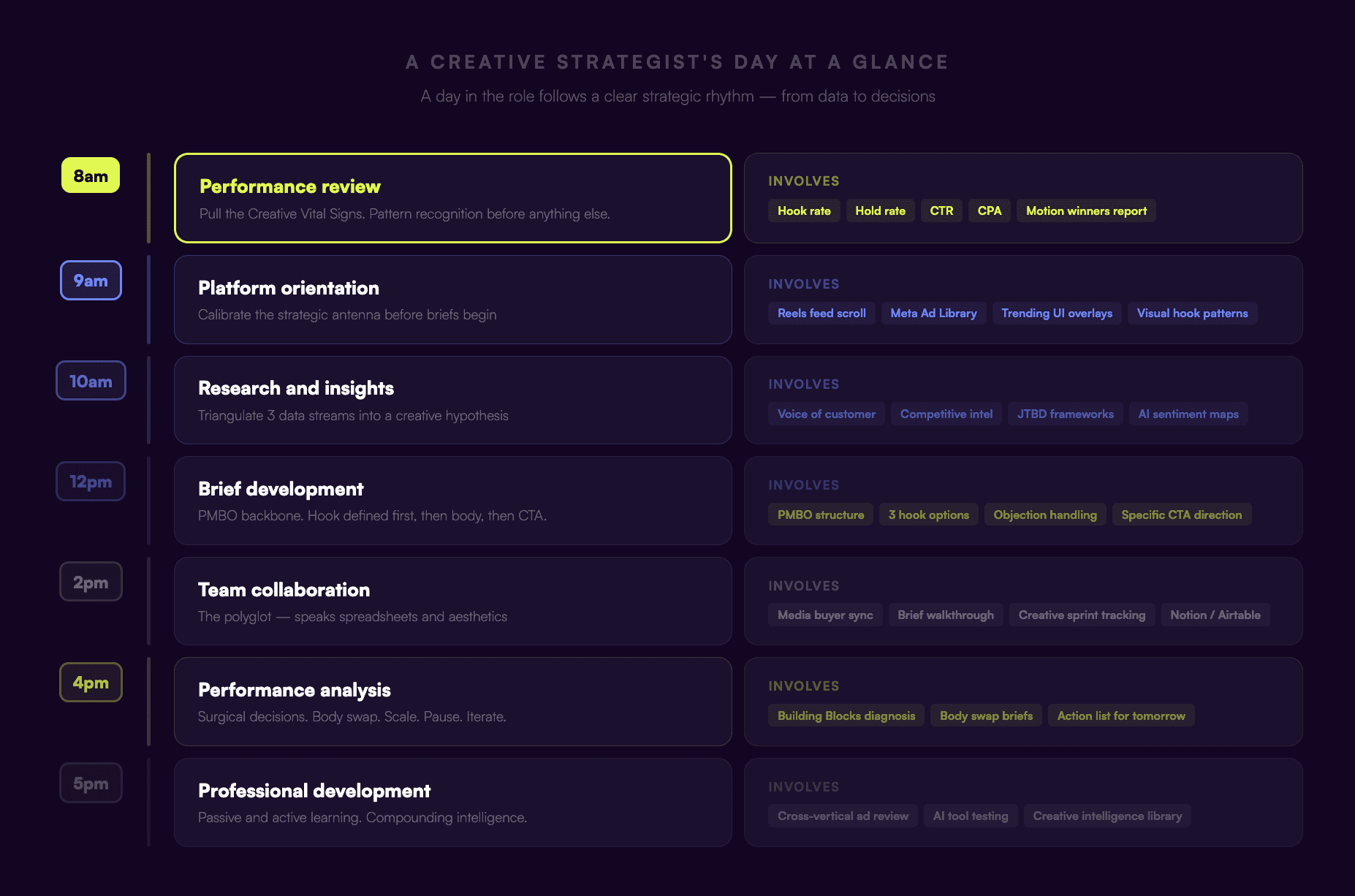
This post breaks down a realistic workday, section by section, so you can understand exactly where the thinking happens, what creative strategist daily tasks look like in practice, and why this role sits at the intersection of data and creativity in a way few other marketing jobs do.
Morning Routine: What Does a Creative Strategist Do First?
The day starts before any "creative" work begins. By 8:00 AM, most creative strategists are already deep in their performance dashboards. In the world of Meta advertising, the morning is about taking the pulse of the account.
A strategist’s first task is opening Meta Ads Manager to review the previous 24 to 48 hours of data. They aren't just looking at the "bottom line" return on ad spend (ROAS); they are looking for the why behind the numbers. This involves pulling specific "Creative Vital Signs": hook rate (the percentage of people who watched the first 3 seconds), hold rate (who stayed until the end), and CTR (who actually clicked).
The goal at this stage is pattern recognition. The strategist asks: Which ads are accelerating? Which ones have started to fatigue? Are there any anomalies, like a sudden spike in CPC, that need attention before the daily team sync?
For strategists at the top of their game, this morning review is increasingly augmented by AI-powered tools like Motion. Instead of manually exporting CSV files, the data is visualized into "Creative Winners and Losers" reports. Performance data gets surfaced and ranked before the strategist even opens a laptop, highlighting specific drop-off points in a video or signaling which creatives are due for an iteration. This shift, from manually pulling reports to reviewing intelligent summaries, has compressed what used to take two hours into thirty minutes of high-quality decision-making.
Once the data review is complete, the strategist moves to "Platform Orientation." They spend 15 minutes scrolling the Reels feed and the Meta Ad Library. They aren't looking for entertainment; they are looking for emerging visual hooks, trending audio, or new UI overlays that competitors are using. This ensures their strategic "antenna" is calibrated to what is currently stopping the scroll.
Key Morning Metrics at a Glance
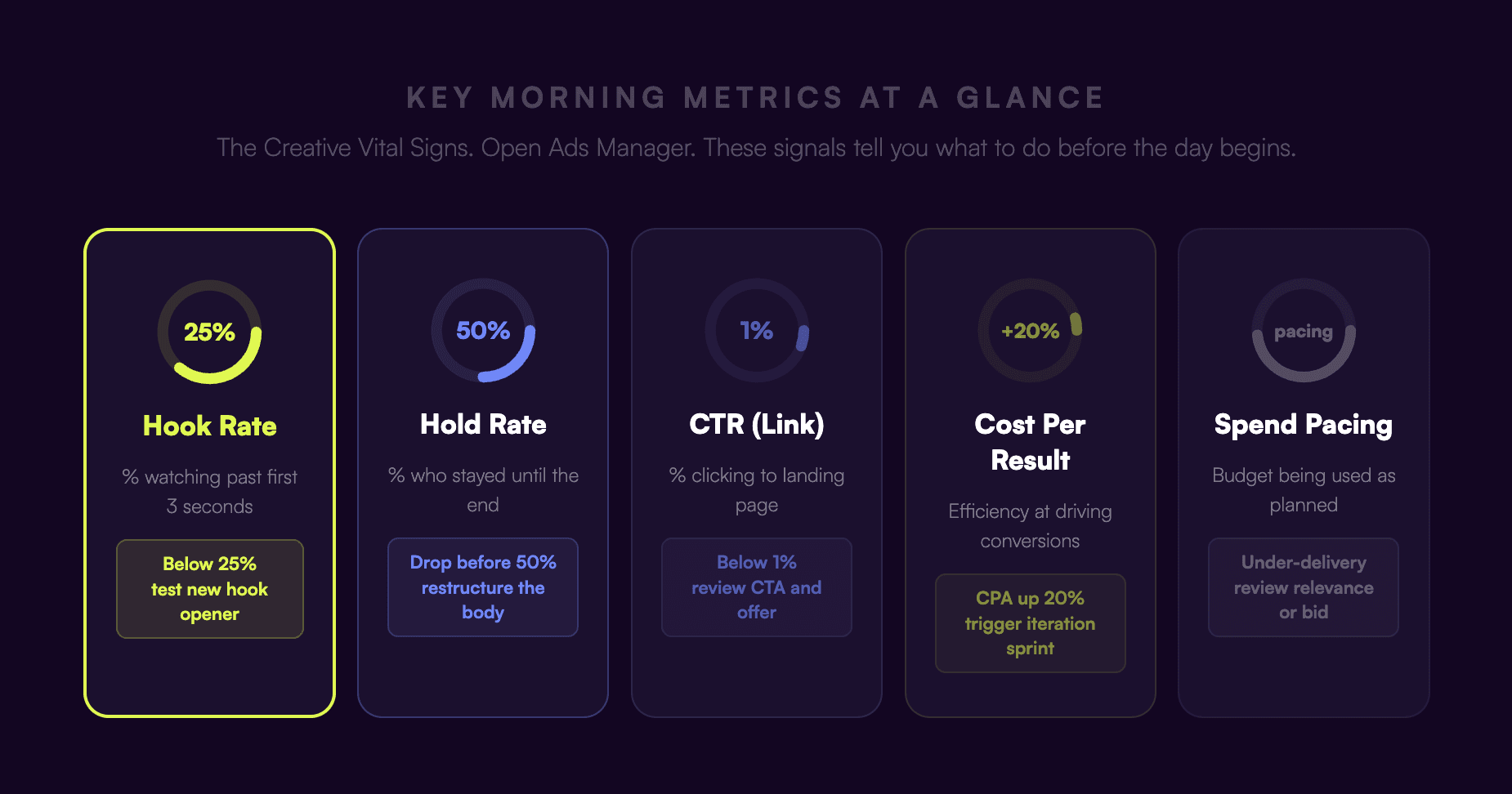
Metric | What It Tells You | Action Threshold |
Hook Rate | % of viewers who watch past the first 3 seconds | Below 25%: test new hook opener |
Avg. Watch Time | How long viewers stay engaged with the body | Drop-off before 50%: restructure the body |
CTR (Link) | % clicking through to the landing page | Below 1%: review CTA direction and offer |
Cost Per Result | Efficiency of the creative at driving conversions | CPA up 20%+: trigger an iteration sprint |
Spend Pacing | Whether budget is being used as planned | Under-delivery: review relevance or bid |
Research and Insights Phase: Building the Strategic Foundation
By mid-morning, the focus shifts from what is happening to why it’s happening. This is where the creative strategist role earns its seat at the table. Research is not about gathering information for its own sake; it is about forming hypotheses that can be tested through creative execution.
A typical research session at Meta involves triangulating three distinct data streams:
1. The Voice of the Customer
Strategists dive into the comments section of live ads and the "Most Recent" reviews on product pages or Amazon. They look for the exact language buyers use. If customers are consistently mentioning that a skincare product "doesn't feel greasy," that becomes a primary hook for the next brief. They also use AI tools like ChatGPT or Claude to synthesize thousands of reviews into "Customer Sentiment Maps," identifying the top three objections and the top three "aha!" moments.
2. Competitive Intelligence
Using the Meta Ad Library, the strategist analyzes the "Creative Longevity" of competitors. If a competitor has had the same video running for three months, it is a high-probability winner. The strategist deconstructs that video: Is it a "Problem/Solution" format? Is it "Founder-led"? What is the specific offer framing? They aren't looking to copy; they are looking to "counter-program" or improve upon the existing market standard.
3. Psychological Frameworks
The strategist applies psychological lenses like Jobs to be Done (JTBD). They ask: What "job" is the customer hiring this product to do? Is it to save time? To gain status? To reduce anxiety? By identifying the underlying emotional driver, the strategist can move beyond generic benefits and create high-impact "Angles."
By the end of this phase, the strategist has moved from raw data to a "Creative Hypothesis." For example: "If we lead with the 'non-greasy' benefit using a texture-close-up hook, we will lower the CPA for the 'Skeptical Buyer' persona." This sets the foundation for the most critical document in the workflow: the brief.
Creative Brief Development: Turning Strategy into Execution
If the research phase is about identifying the right angle, brief development is about turning that angle into a clear, executable creative direction. This is a core creative strategist daily task—and the quality of a brief determines the quality of everything downstream.
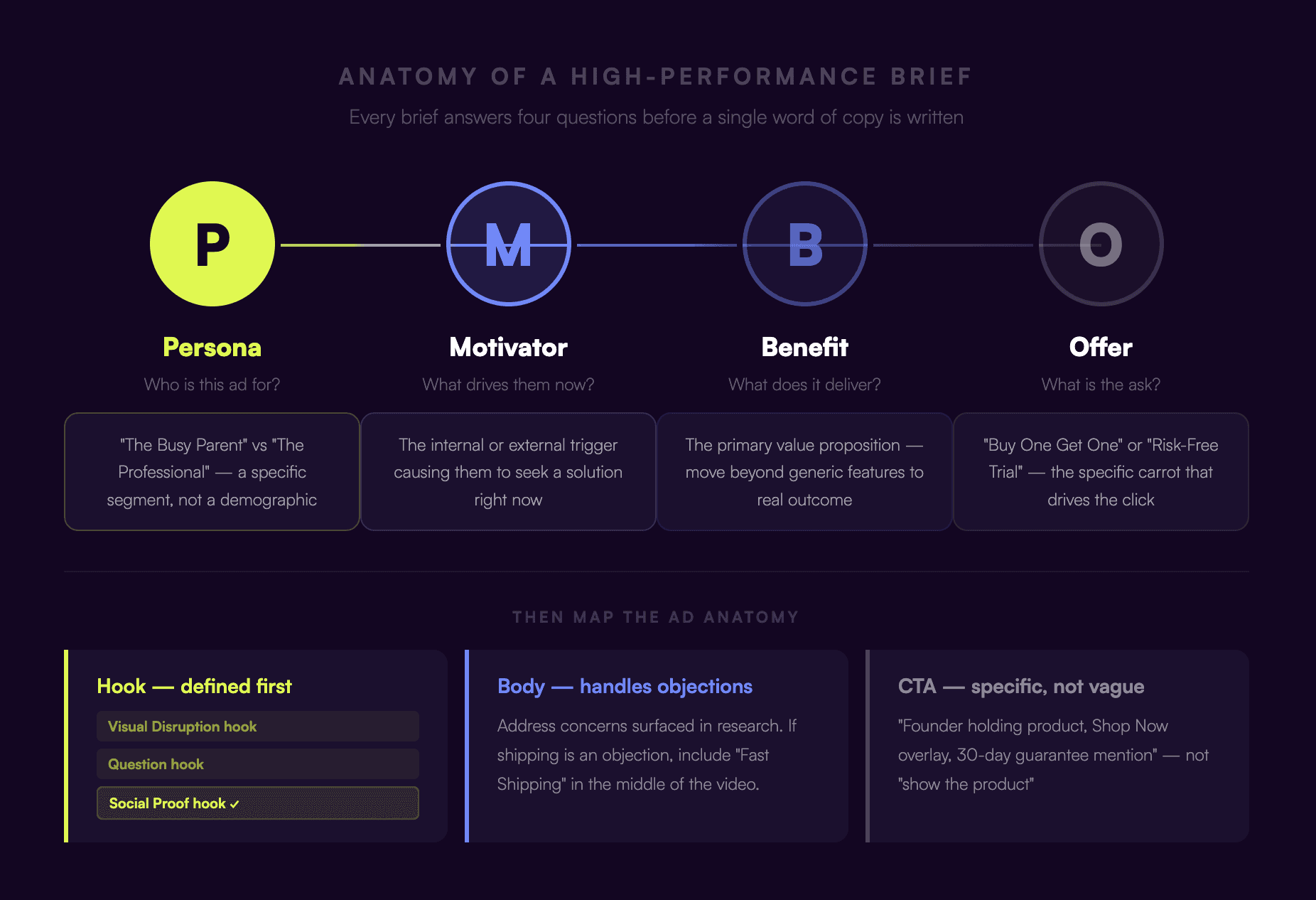
A high-performance brief at Meta is not a 10-page document. It is a precise, tactical blueprint. Most senior strategists utilize the PMBO Framework to ensure every ad has a structural backbone:
Persona (P): A specific segment of the audience (e.g., "The Busy Parent" vs. "The Professional").
Motivator (M): The internal or external trigger causing them to seek a solution.
Benefit (B): The primary value proposition of the product.
Offer (O): The specific "carrot" that drives the click (e.g., "Buy One Get One" or "Risk-Free Trial").
From there, the strategist maps out the Ad Anatomy. Because Meta is a "sound-off" and "scroll-fast" environment, the Hook is defined first. The strategist might provide three distinct hook options for the editor: a "Visual Disruption" hook, a "Question" hook, and a "Social Proof" hook.
Then comes the Body Structure. This is where the strategist handles objections identified in the research phase. If the research showed people are worried about shipping times, the strategist ensures a "Fast Shipping" badge or mention is included in the middle of the video.
Finally, the CTA (Call to Action) is defined. It must feel like a natural conclusion to the story told in the ad. Specificity is key: instead of "Show the product," the brief will say: "Close with a 3-second shot of the founder holding the product, with a 'Shop Now' overlay and a mention of the 30-day guarantee."
Team Collaboration: The Bridge Between Data and Production
Creative strategy is inherently collaborative. A significant part of the afternoon involves "The Bridge." In a typical Meta team structure, the strategist sits between the Media Buyers (who manage the budget) and the Content Creators/Editors (who make the assets).
Bridging the Gap
With Media Buyers: The strategist discusses which "Creative Concepts" are ready for testing. They align on naming conventions so that the data coming back is easy to attribute to specific strategies.
With Editors/UGC Creators: The strategist "walks through" the briefs. They explain the why behind the hook. If an editor understands that the hook is designed to stop a "skeptical buyer," they will choose different music and pacing than if it were for a "warm lead."
With Creative Directors: They ensure that while the ad is "performance-first," it doesn't degrade the brand's long-term equity.
This requires the strategist to be a "polyglot"—speaking the language of spreadsheets to the buyer and the language of aesthetics to the editor. At scale, this collaboration often happens across 10 to 20 briefs simultaneously. To manage this, strategists use "Creative Sprints," often managed in Notion or Airtable, to track an asset from "Briefing" to "Production" to "Live" to "Iterated."
Performance Analysis: Turning Results Into Decisions
In the late afternoon, the strategist returns to the data, but this time with a "surgical" lens. They aren't just checking if things are working; they are deciding what to do next. This is where the Building Blocks approach to creative iteration comes into play.
Instead of seeing an ad as a single unit, the strategist sees it as a collection of variables: Hook + Body + CTA + Visual Style + Headline. If the data shows a high hook rate but a massive drop-off at the 5-second mark, the strategist doesn't scrap the ad. They identify that the Body is the problem. They will then brief a "Body Swap", keeping the winning hook but testing two different middle sections. This surgical approach minimizes production costs and maximizes the "Win Rate" of new uploads.
Creative Iteration Decision Framework
Signal | What It Points To | Recommended Action |
Low hook rate (<25%) | Hook is not stopping the scroll | Test 3 new hook variations; keep body + CTA |
Good hook, low watch time | Body loses attention after the opener | Rewrite or restructure the body; keep hook |
Strong watch time, low CTR | Message resonates but offer is unclear | Revise CTA direction and offer framing |
Good CTR, high CPA | Traffic quality or landing page mismatch | Review audience signal; test a new angle |
The goal of this afternoon session is to leave the office with a clear "Action List" for the next morning: Which ads to scale, which to pause, and which to iterate on.
Professional Development: How the Best Stay Sharp
A creative strategist at Meta is operating in one of the fastest-moving environments in history. The platform updates weekly, and AI capabilities shift the workflow monthly. Staying current is a non-negotiable daily task.
The best strategists spend the final hour of their day in "Passive and Active Learning."
Passive Learning: Reviewing "top ads" in completely unrelated verticals (e.g., looking at FinTech ads for a Beauty brand) to find structural patterns that haven't been overused yet.
Active Learning: Testing new AI tools. This might mean seeing if a new "AI Voiceover" tool sounds human enough to replace a paid actor, or using AI image generators to storyboard a video more clearly for an editor.
They also contribute to the team’s Creative Intelligence Library—a shared folder of "Hooks that worked" and "Visual transitions that stopped the scroll." This compounding knowledge is what separates a junior strategist from a senior lead.
Tools They Use Daily
The toolkit has evolved from simple spreadsheets to a sophisticated "Stack." Here is what a day in the role actually requires:
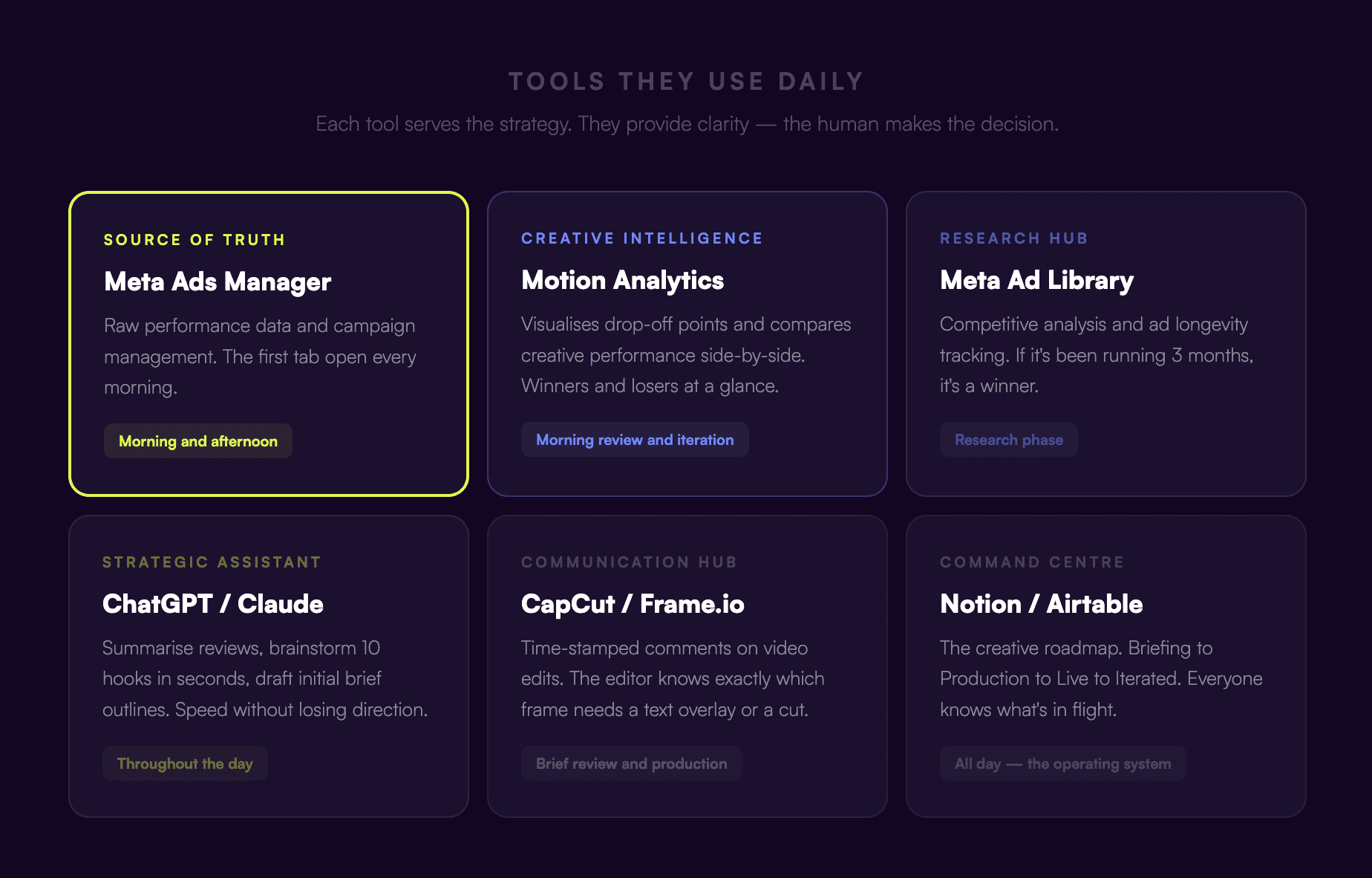
Meta Ads Manager: The "Source of Truth" for raw performance data and campaign management.
Motion: The "Creative Intelligence" layer. It visualizes Ads Manager data so strategists can see where people stop watching and compare creative performance side-by-side.
Meta Ad Library: The primary research hub for competitive analysis and "Ad Longevity" tracking.
ChatGPT / Claude: The "Strategic Assistant." Used for summarizing customer reviews, brainstorming 10 hook variations in seconds, and drafting initial brief outlines.
CapCut / Frame.io: The "Communication Hub." Strategists use these to leave time-stamped comments on video edits, ensuring the editor knows exactly which frame needs a text overlay or a cut.
Notion / Airtable: The "Command Center." This is where the creative roadmap lives, ensuring everyone knows which assets are in production and which are live.
The common thread is that these tools serve the strategy. They don't make the decisions; they provide the clarity needed for a human strategist to make the right decision faster.
How to Build These Skills
The day described above requires a specific combination of analytical rigor, creative instinct, and platform fluency. As AI continues to automate the "technical" parts of media buying, the role of the Creative Strategist is becoming the most valuable position in the marketing ecosystem.
Programs like Ad Creative Academy are built specifically to bridge this gap. Our curriculum is developed by practitioners who are currently running these workflows for global brands. We cover everything from "The Anatomy of a High-Performing Brief" to "AI-Driven Research Workflows."
If you want to move beyond "making ads" and start "building winning creative systems," this is the path.
The Bottom Line
Reading about a creative strategist's day is useful. Understanding why each part of the workflow exists is better. But building the skills to operate this way yourself, that is where everything changes.
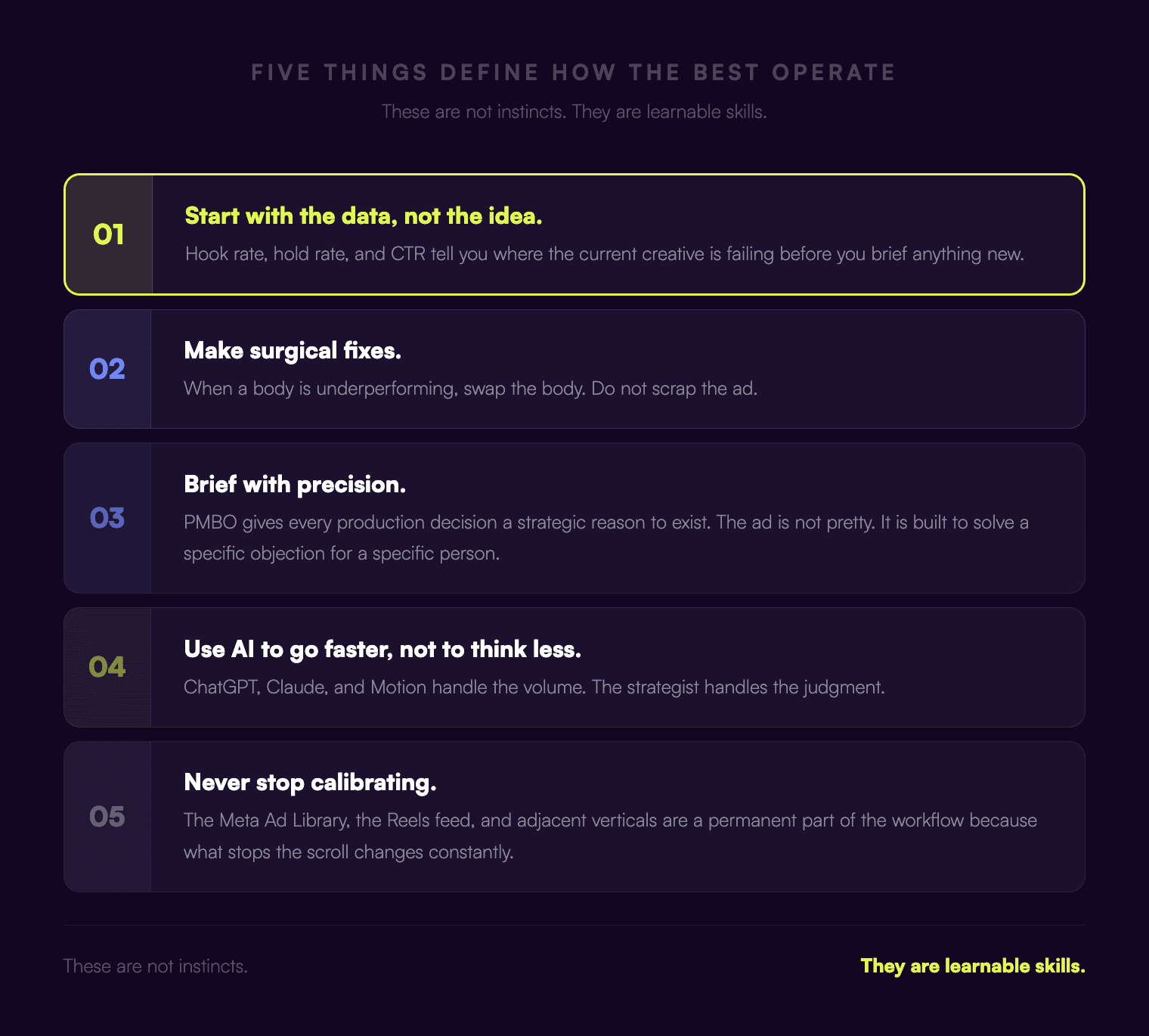
The role described in this post is not a mystery. It follows a repeatable rhythm: start with data, form a hypothesis, build a precise brief, collaborate across the team, analyze the results, and feed those learnings back into the next cycle. The strategists doing this well at Meta and the top performance agencies are not more creative than everyone else. They are more systematic.
Ready to build them?
Ad Creative Academy is the world's first professional certification for AI-powered creative strategy. Our curriculum was built by the practitioners running these exact workflows for global brands, including faculty from Meta, Motion Analytics, and leading performance creative agencies.
If the day described in this post is where you want to be, this is how you get there.