
If you've searched "what is a creative strategist," you've probably already noticed that the answers don't quite agree. Some define it as a glorified copywriter. Others describe it as a hybrid media buyer. A few sources reduce it to someone who writes briefs. None of those definitions are wrong, exactly. But none of them are precise enough to be useful.
This guide gives you the specific, current definition: what a creative strategist actually does, why the role exists, what skills it requires, how it relates to other marketing roles, and what a realistic career in creative strategy looks like in 2026. Whether you're trying to understand the role for the first time or evaluating whether it's the right career direction, this is the complete picture.
1. The Definition: What a Creative Strategist Actually Does
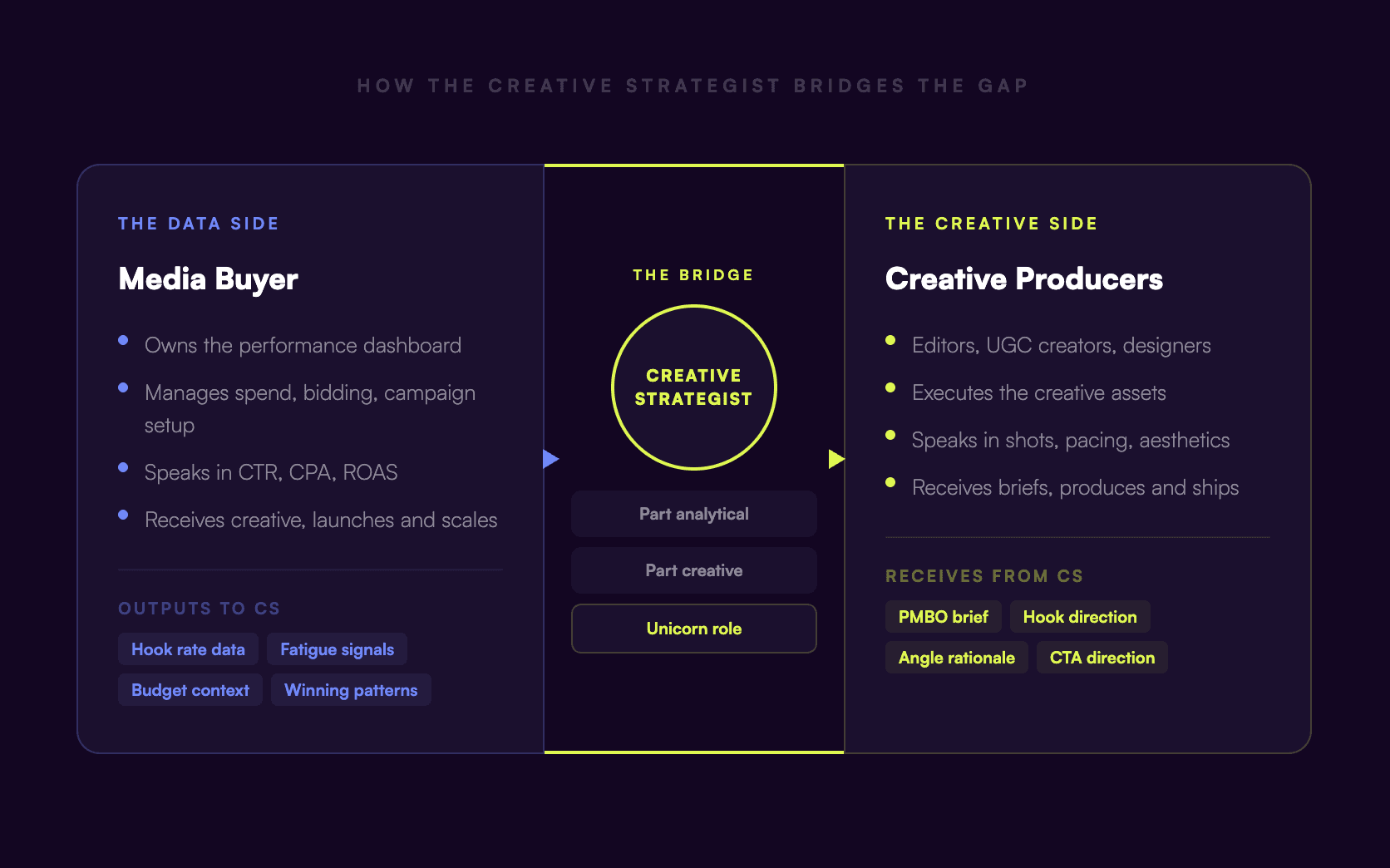
A creative strategist sits at the intersection of creativity and data, serving as the vital link between media buyers and content creators. Their job, in its simplest form, is to ensure that every ad is built for performance: grounded in what the audience actually responds to, structured for the platform it runs on, and connected to the commercial outcomes the business is trying to drive.
That definition matters because it immediately tells you what the role is not. It is not purely creative. It is not purely analytical. It is not about executing the work itself. A creative strategist does not typically shoot videos, edit footage, design layouts, or manage ad campaigns directly. The role sits one level above all of those functions, connecting them.
The clearest way to understand why the role exists is to look at the relationship between media buying and content production. Historically, those two functions operated in parallel. Media buyers optimised campaign settings and targeting while creative teams produced assets independently, often without deep visibility into performance data. Creative strategists emerged to bridge that gap: translating what the data says into direction that production teams can act on, and translating what production teams create into outcomes that media buyers can scale.
Creative strategy is, as Mirella Crespi (CEO at Creative Milkshake and Head of Faculty at Ad Creative Academy frames it, the combination of art and science: merging emotional storytelling with data-driven decision making, crafting messages that address the audience's deepest pain points while using performance data to continuously refine the approach.
The table below maps each core responsibility to what it looks like in practice:
Core Responsibility | What It Means in Practice |
Performance analysis | Reading ad metrics (CTR, CPA, ROAS, hook rate, hold rate) to diagnose what is and is not working in an active creative portfolio. |
Brief development | Translating performance insights and audience research into production-ready creative briefs that guide copywriters, designers, and video producers. |
Angle development | Identifying the right emotional hooks, pain points, and value propositions for a given audience segment and offer. |
Creative iteration | Generating variants of proven concepts to extend their lifespan and uncover new audience pockets, rather than building every campaign from scratch. |
Cross-team communication | Acting as the translator between media buyers (who own the data) and creative producers (who make the work), ensuring both sides operate from the same strategic intent. |
2. What a Creative Strategist Does Day-to-Day
The daily reality of the role is more operational than the definition might suggest. A significant portion of a creative strategist's time is spent in data: reviewing performance dashboards, identifying patterns across an active creative portfolio, and diagnosing what is fatiguing, what is scaling, and what gaps exist in the current mix.
From that analysis comes brief writing. A good brief is not a vague creative direction. It is a structured document that captures the target persona, the emotional motivator, the core benefit, the offer, and the specific angles to test. It gives production teams everything they need to execute without making the creative decisions for them.
Alongside briefs, creative strategists spend meaningful time on audience research: reading competitor ad libraries, scrolling comment sections, reviewing product reviews and forums, and building a picture of the exact language, fears, and desires that make a specific audience move. This research feeds directly into the hooks, angles, and messaging that make ads work.
Collaboration is constant. The role requires regular sync with media buyers to understand performance context and budget allocation, and with producers, creators, and editors to keep creative production moving. The strategist is often the one translating between those groups, making sure both sides understand what the other needs.
For a detailed look at how this plays out across a real workday, see our Day in the Life of a Creative Strategist post.
The table below maps daily tasks to the skills they require:
Daily Task | What It Involves | Skill Required |
Performance review | Pulling data from Ads Manager or analytics tools to identify fatigue, winners, and gaps | Data analysis, platform literacy |
Brief writing | Translating data insights into clear creative direction for producers and creators | Written communication, strategic thinking |
Audience research | Reviewing competitor ads, comment sections, reviews, and forums for messaging cues | Consumer psychology, curiosity |
Team sync | Aligning with media buyers on spend allocation and with producers on production capacity | Collaborative translation, leadership |
Iteration planning | Deciding which top-performing ads to extend, which angles to test next, and what to retire | Analytical rigour, creative judgment |
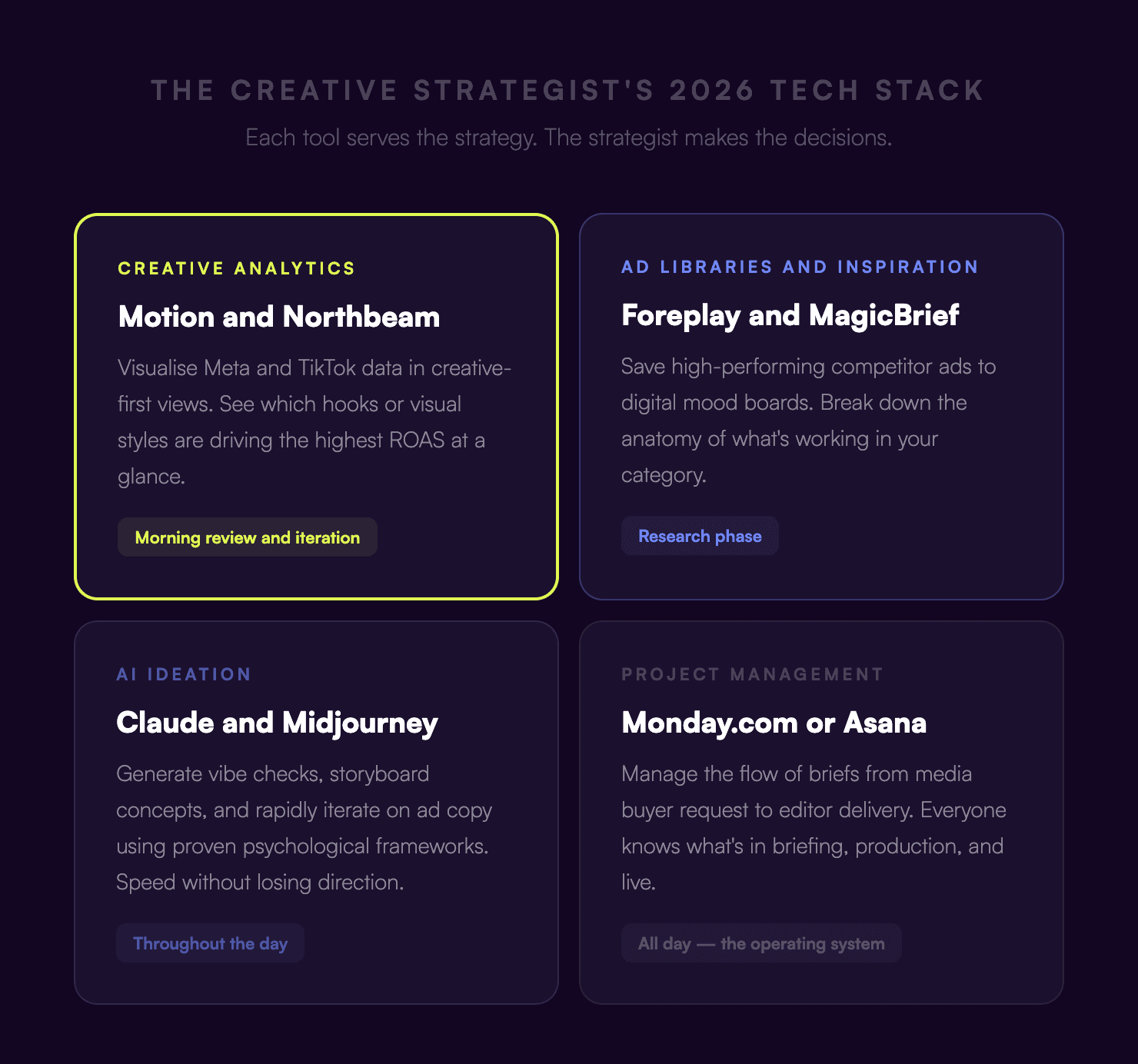
The Creative Strategist's 2026 Tech Stack
To operate at a high level in 2026, a creative strategist must be proficient in a specific suite of tools that bridge the gap between raw data and creative execution.
3. The Three Core Skills
Most performance marketing roles require either creative talent or analytical capability. Creative strategy requires both, and adds a third dimension that makes the role genuinely distinct. ACA's curriculum identifies three essential qualities that the best creative strategists share, each of which is non-negotiable in a different way.
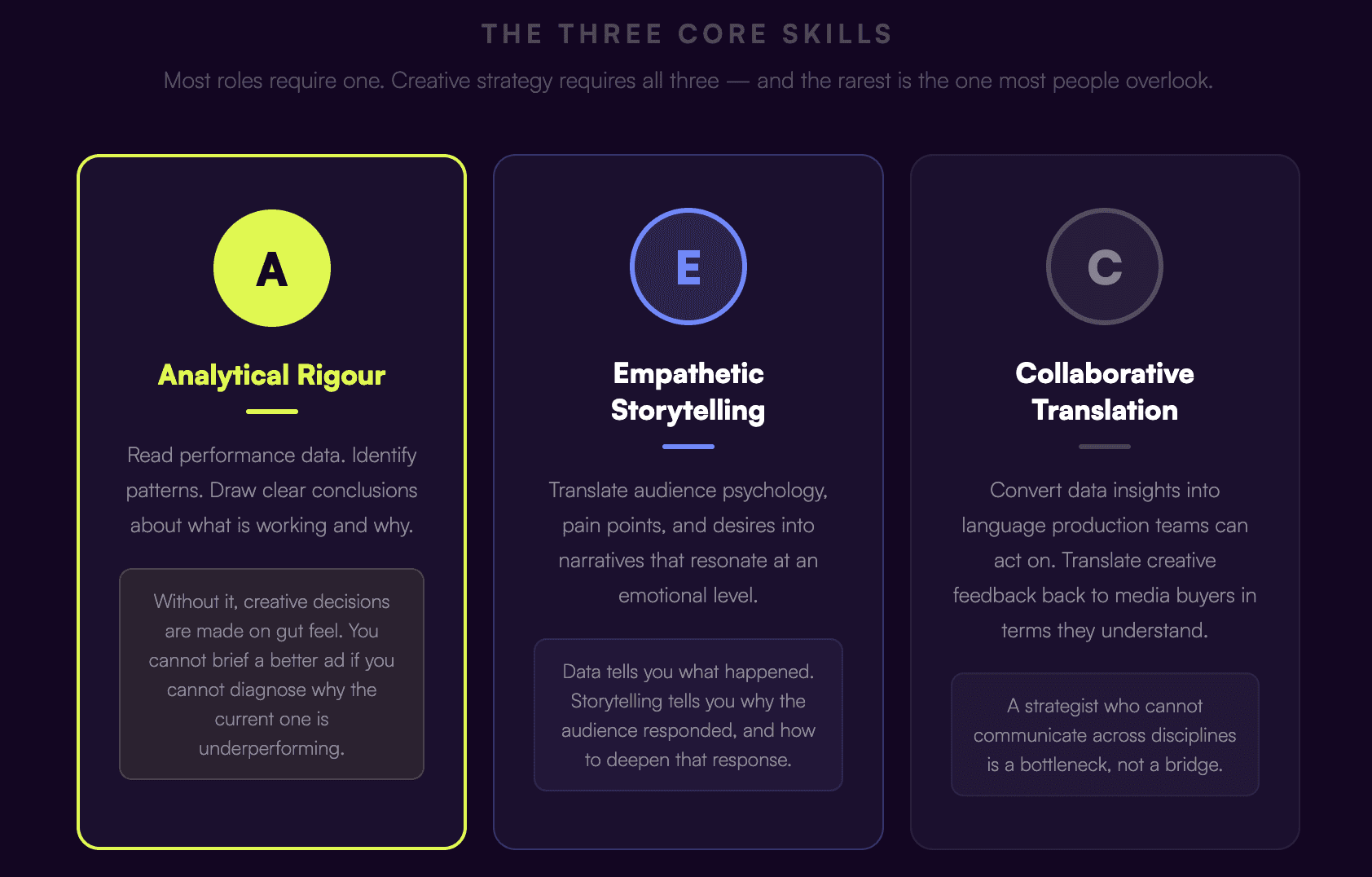
It is worth emphasizing that collaborative translation is often the underestimated skill in this list. Analytical rigour and empathetic storytelling are both well-understood capabilities. The ability to move fluidly between data fluency and creative direction, in a single conversation with two entirely different kinds of people, is rarer and harder to develop.
"If you're a creative strategist, you are the bridge that connects data and creative production and you orchestrate the system and glue it all together."
Mirella Crespi, Head of Faculty, Ad Creative Academy
4. How the Role Emerged: A Brief History
The creative strategist role as it exists today is largely a product of one event: Apple's iOS 14 privacy update in 2020.
Before iOS 14, Meta advertisers operated in a world of granular data. The pixel collected rich third-party data that made it possible to build highly detailed lookalike audiences, run precise retargeting campaigns based on three, seven, and thirty-day windows, and exclude recent purchasers with accuracy. The algorithm was doing most of the heavy lifting: it could reliably find the right person for your ad and show it to them at the right time. In that environment, creative quality mattered, but it was not the primary lever. You did not need a brilliant ad when the targeting was doing the work.
iOS 14 changed the data landscape fundamentally. Third-party tracking collapsed. Pixel-based audience building became significantly less reliable. Meta's algorithm shifted toward first-party signals: what people did inside the app. If someone stopped scrolling for your video, watched it, shared it, clicked it, those became the primary signals the algorithm used to find more people like them.
The practical implication was direct: creative became the targeting. Instead of identifying the right person and showing them an average ad, advertisers now needed to make an ad so specifically resonant that it would find the right person on its own, through the signal it generated. That required a fundamentally different kind of thinking. You needed someone who could read performance data, understand audience psychology, develop angles, test hypotheses, and iterate with discipline. That person became the creative strategist.
"Everyone very immediately understood that creative was where the big revenue unlock was... Creative Strategists emerged as the bridge between these two worlds."
Reza Khadjavi · CEO, Motion Analytics
The shift from 2020 to 2026 represents a total inversion of the marketing funnel. Before the privacy updates, the Media Buyer was the pilot; today, the Creative Strategist provides the engine.
Broad Targeting is the New Norm: In 2026, the most effective Meta campaigns often use "Broad" targeting (no interests, no lookalikes). This means the algorithm relies entirely on the creative's "hook" to find the audience.
The "Hook Rate" Revolution: Strategists now obsess over the first 3 seconds of a video. If the hook rate (3-second views / impressions) is low, the strategist diagnoses if it's a visual problem or a messaging mismatch, rather than just asking the media buyer to change the audience settings.
5. Creative Strategist vs. Other Roles
One of the most common points of confusion about creative strategy is how it relates to other marketing roles. People coming from copywriting, design, or media buying often wonder where the boundaries are. The table below makes the distinctions explicit.
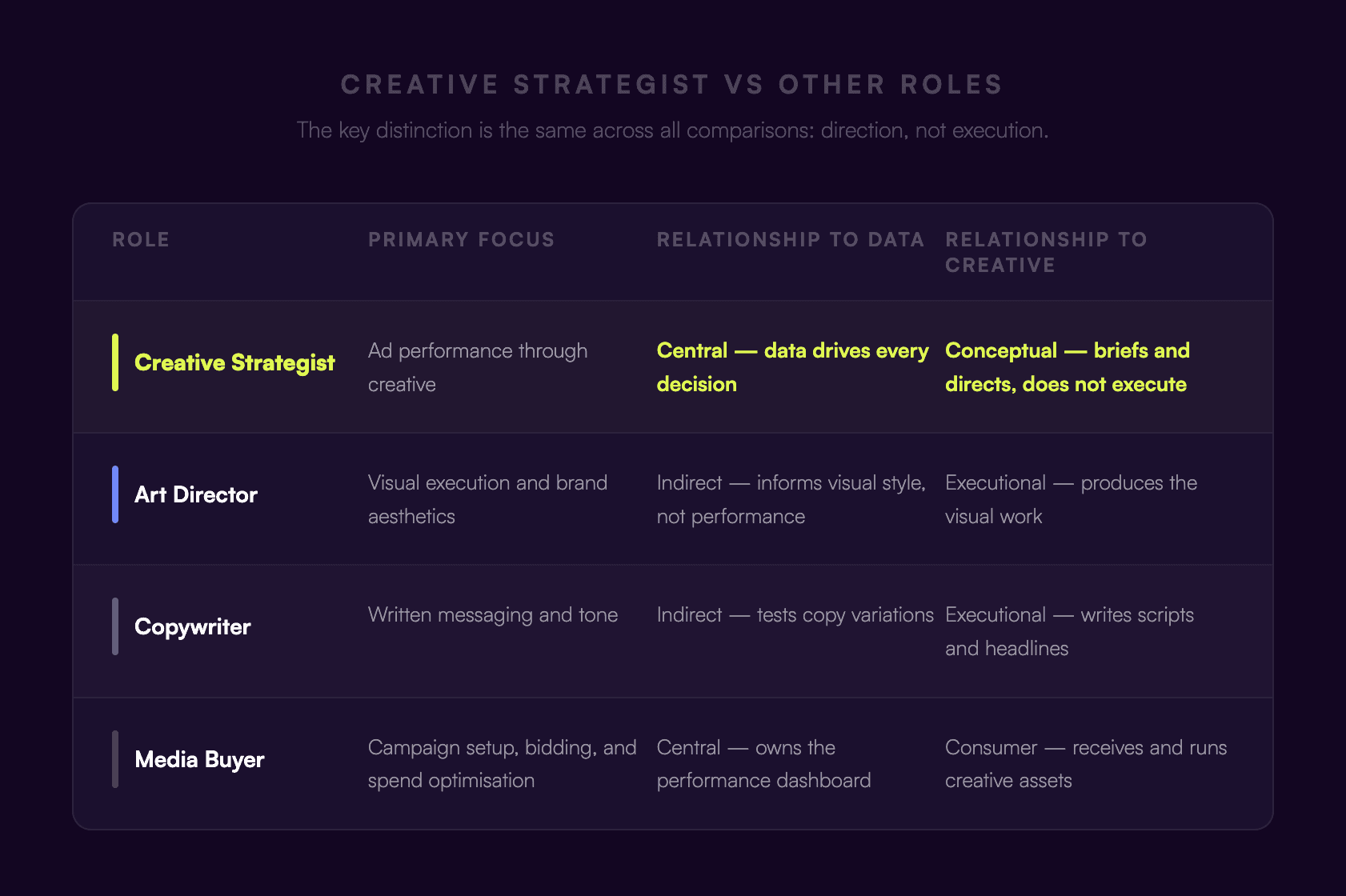
The key distinction across all three comparisons is the same: creative strategists operate at the level of direction, not execution. They own the thinking that determines what gets made and why. They rely on art directors, copywriters, and media buyers to execute within that strategic frame, and they translate between all of those functions to keep the system coherent.
It is also worth noting that the creative strategist role has significant overlap with each of these adjacent roles. Many successful creative strategists come from copywriting backgrounds and retain strong writing skills. Others come from media buying and bring genuine depth in performance analytics. Neither background disqualifies someone from the role. The strategist who understands both sides of the fence, even if they started on one side, tends to be the most effective.
6. What Skills Do You Need?
The skill set required for creative strategy is genuinely cross-disciplinary, which is part of what makes the role valuable and part of what makes it hard to teach in a traditional marketing curriculum. The table below breaks down the core skills, why each one matters, and how you develop it.
Skill Category | Why It Matters | How You Build It |
Performance marketing fundamentals | Understanding CPAs, ROAS, CTR, and the ad auction gives your creative decisions a commercial foundation | Work in or alongside paid media teams; study platform dashboards directly |
Audience psychology | The most effective angles are rooted in how people actually make decisions, not how brands assume they do | Study consumer psychology frameworks: the Five Stages of Market Awareness, motivators, and behavioural triggers |
Brief writing | A weak brief produces weak creative. The ability to write a precise, strategic brief is what makes your strategic thinking actionable | Practice writing briefs using structured frameworks; apply PMBO (Persona, Motivator, Benefit, Offer) to real campaigns |
Data analysis | You cannot improve what you cannot measure. Reading creative analytics is as important as reading campaign performance | Learn Ads Manager inside out; use creative analytics tools like Motion to track patterns across your portfolio |
AI tools and workflows | AI accelerates research, ideation, scripting, and iteration at a scale that manual processes cannot match | Build practical prompting skills; learn to use AI as a creative system, not just a text generator |
Platform knowledge (Meta, TikTok, YouTube) | Each platform has its own creative logic. What works on Meta does not automatically work on TikTok. | Study platform best practices; run your own tests; study what high-spend advertisers are publishing |
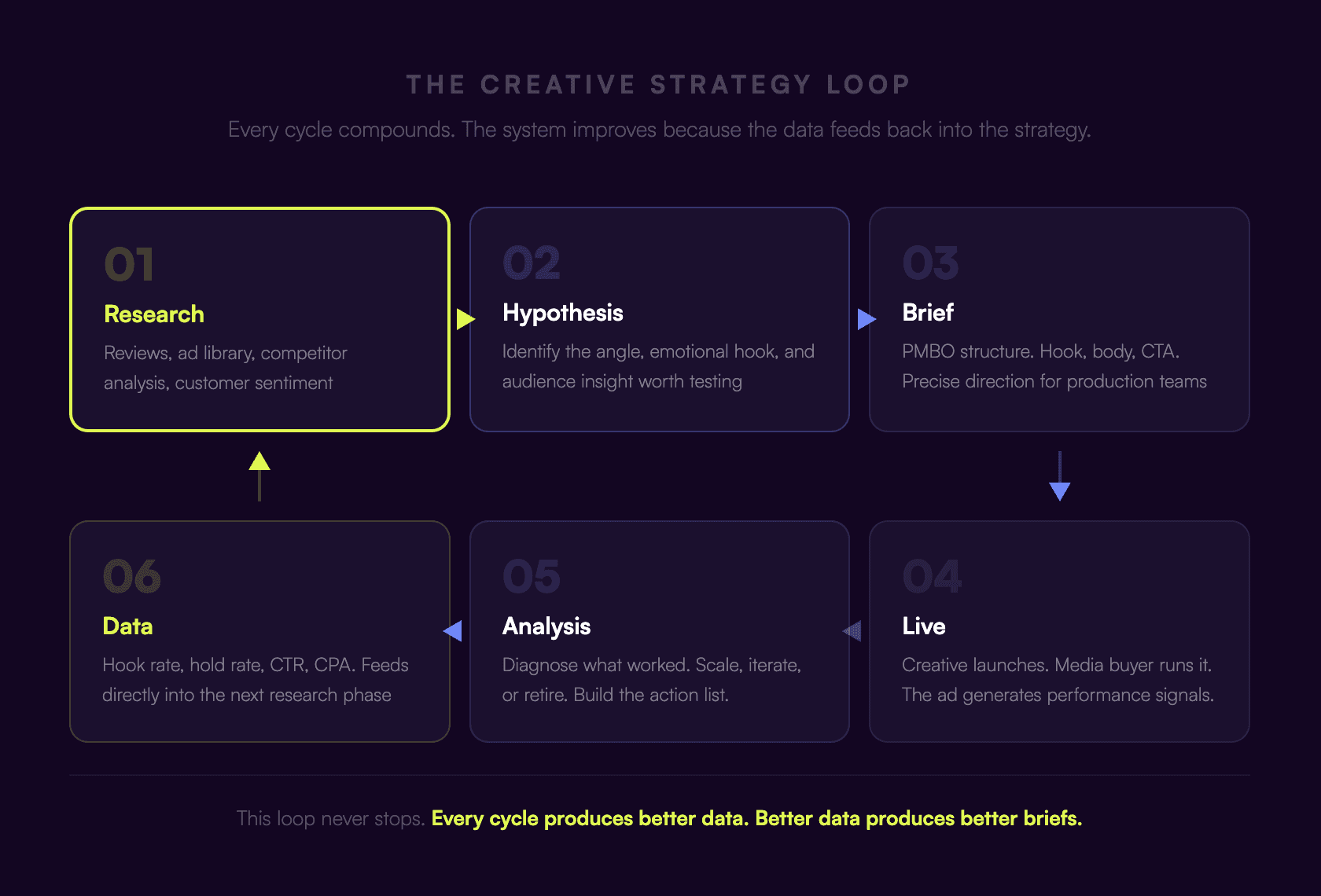
The through-line across all of these skills is systems thinking. The best creative strategists are not just good at individual tasks; they are good at connecting them. They see how a consumer psychology insight becomes an angle, how an angle becomes a brief, how a brief becomes a script, how a script becomes an ad, and how an ad generates data that feeds the next brief. That loop is creative strategy in action.
Programs like the Ad Creative Academy certification are built around this exact skill set, teaching each of these disciplines in sequence and showing how they connect into a working system.
7. Career Paths and Salary
Creative strategists come from a wide range of backgrounds. The most common entry points are media buying (which gives strong analytical foundations), copywriting (which builds message craft and audience intuition), social media management (which builds platform fluency and content instincts), and brand marketing (which provides a strategic overlay that can be retrained toward performance). There is no single standard path.
What matters more than the entry point is the combination of skills someone brings or develops. A media buyer who builds their creative intuition is a strong creative strategist candidate. So is a copywriter who develops genuine analytical rigour. The role rewards people who close the gap between the two.
Career progression typically follows this arc: a junior strategist supports the development of briefs and research under supervision, gaining exposure to the full workflow. A mid-level strategist owns the full cycle independently, across one or more clients or product lines. Senior and lead strategists begin shaping frameworks, building infrastructure (testing systems, brief templates, reporting structures), and mentoring others. Head of Creative Strategy and Creative Director roles add team leadership and organisational responsibility.
Note: Salary figures below reflect 2025/2026 benchmarks and should be verified against current sources such as LinkedIn Salary, Glassdoor, and industry surveys at time of publication.
Level | Typical Experience | Core Responsibilities | Approximate Salary (USD) |
Junior Creative Strategist | 0-2 years | Supporting brief development, running competitor research, assisting with iteration planning under senior oversight | $45,000 - $65,000 |
Creative Strategist | 2-4 years | Owning the full strategy cycle: research, briefing, analysis, iteration. Managing relationships with media buyers and production teams independently | $65,000 - $100,000 |
Senior Creative Strategist | 4-7 years | Leading creative strategy for multiple accounts or brands, mentoring junior strategists, shaping frameworks and testing infrastructure | $100,000 - $140,000 |
Head of Creative Strategy / Creative Director | 7+ years | Setting the strategic direction for an entire creative function, hiring, managing a team, and reporting to growth or marketing leadership | $140,000 - $200,000+ |
Salaries vary meaningfully based on geography, industry, and whether the role is in-house at a direct-to-consumer brand, at a performance agency, or in a freelance capacity. Freelance creative strategists with strong track records often command day rates of $600 to $1,200+, particularly in high-spend verticals like DTC, fintech, and consumer apps.
8. Is This the Right Career for You?
Creative strategy is genuinely one of the more demanding career paths in marketing, and it is not the right fit for everyone. Being clear-eyed about that is worth more than a sales pitch.
The role suits people who are comfortable working at the intersection of data and creative without feeling like they belong exclusively in either world. If you are energised by the question of why something works, not just whether it works, this role rewards that curiosity over time. It also suits people who enjoy translation: taking something complex and technical and making it legible to someone on the creative side, or taking something intuitive and aesthetic and connecting it to commercial logic for someone on the analytics side.
It is genuinely not the right role for people who want to produce creative work directly. If the craft of writing, designing, or directing is what drives you, creative strategy will feel like it keeps you at arm's length from the work you actually love. Similarly, it is not the right role for people who want to operate purely in data. The job is always pulling you back toward the creative and the human, and that balance is essential to it.
"The most valuable creative strategists aren't the ones who are always right. They're the ones who know how to build a system that finds what works."
Chloe Rhys, Ex-Executive Creative Director at TubeScience
9. How to Become a Creative Strategist
There are three practical entry paths into creative strategy. The first is transitioning from an adjacent role: if you are already working in paid media, copywriting, social media, or brand marketing, you are closer than you might think. The transition typically involves developing the skills you are currently weakest in and building a portfolio that demonstrates your strategic thinking, not just your executional ability.
The second is self-study. There is a significant body of freely available knowledge about performance marketing, creative testing, and audience psychology. Reading widely, running your own tests (even at small scale), and studying high-performing ad creative systematically can build a strong foundation. The limitation of self-study is that it is slow, unstructured, and leaves significant gaps in systems thinking.
The third is structured training. Ad Creative Academy's certification program is one structured option, built specifically to train creative strategists in the frameworks, workflows, and practical skills the role requires. Whatever path you choose, the goal is the same: build a portfolio of strategic thinking, not just executional work, and demonstrate that you can connect data to creative decisions.
If you want to go deeper on any of the frameworks or skills referenced in this guide, the Ad Creative Academy covers each of them in full, taught by practitioners who have built and run creative strategy at scale. The certification program is designed for people who want to make the transition into creative strategy, or sharpen the skills they already have, with a structured path rather than a patchwork of resources.
Enroll in Ad Creative Academy to become certified creative strategist.