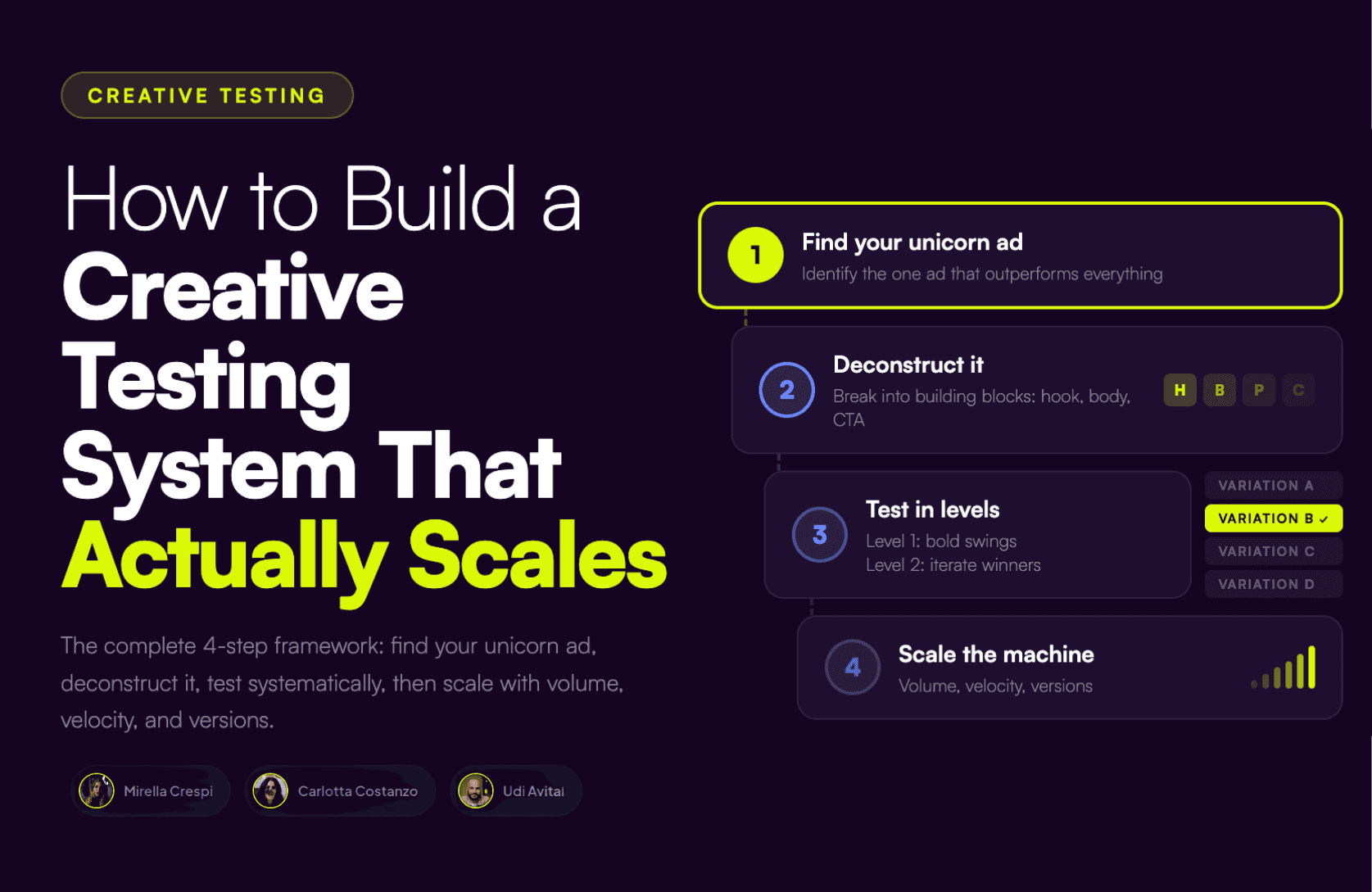

The Uncomfortable Truth About Creative Testing
Here's what nobody tells you about creative testing: 90% of advertisers are doing it wrong.
They test random hooks. They A/B test colors. They debate whether the CTA should be "Learn More" or "Shop Now." Meanwhile, the brands actually winning at scale are running a completely different playbook.
The top 1% of advertisers produce 50-100 new ad variations per week. They systematically deconstruct winners into modular components. They've built creative machines that generate, test, and iterate with mathematical precision.
This isn't about having better creative instincts. It's about having better systems.
Why Most Creative Testing Fails
Most creative testing fails because it lacks structure. Marketers throw spaghetti at the wall, test whatever feels different, and hope something sticks. They confuse motion with progress.
The data tells a different story. Meta's internal research shows that advertisers who run 15+ structured experiments per year see 30% performance improvements. Those who maintain this discipline for two consecutive years see 45% uplift. But here's the key word: structured.
Random testing teaches you nothing. Systematic testing builds a knowledge engine that compounds over time.
As Professor Mirella Crespi teaches in her ACA course on Creative Strategy: "Every ad creative is a hypothesis that needs to be tested. Whenever you put budget behind your creative, you know exactly what you are learning."
The difference between testing and learning is intentionality.
Step 1: Find Your Unicorn Ad
Before you can build a testing system, you need to understand what winning actually looks like in your account. Every successful ad account has what Professor Crespi calls a "Unicorn Ad." This is the one creative that consistently outperforms everything else, takes disproportionate spend, and maintains performance over extended periods.
Your Unicorn Ad is your North Star. It's the genetic code of what works for your brand, audience, and offer.
How to Identify Your Unicorn
Pull your ad performance data for the last 90 days. Look for the creative that meets these criteria:
Takes 20%+ of total spend consistently
Maintains cost per acquisition below account average
Runs profitably for 30+ days without significant decay
Generates the highest lifetime value customers
Don't confuse your Unicorn with a flash-in-the-pan viral creative. Unicorns have endurance. They work because they tap into something fundamental about your customer's psychology, not just a momentary trend.
Once you've identified your Unicorn, resist the urge to kill it or "refresh" it. This creative is giving you a masterclass in what converts your audience. Your job is to learn from it, not replace it.
The Unicorn Audit
Study your Unicorn like a forensic scientist. What pain point does it address? How does it frame the problem? What proof elements does it include? How does it handle objections?
Document everything: - Opening hook and emotional trigger - Problem identification and agitation - Solution presentation method - Social proof type and placement - Demonstration or explanation approach - Call-to-action framing and urgency
This analysis becomes the foundation of everything you build next.
Step 2: Deconstruct with Building Blocks
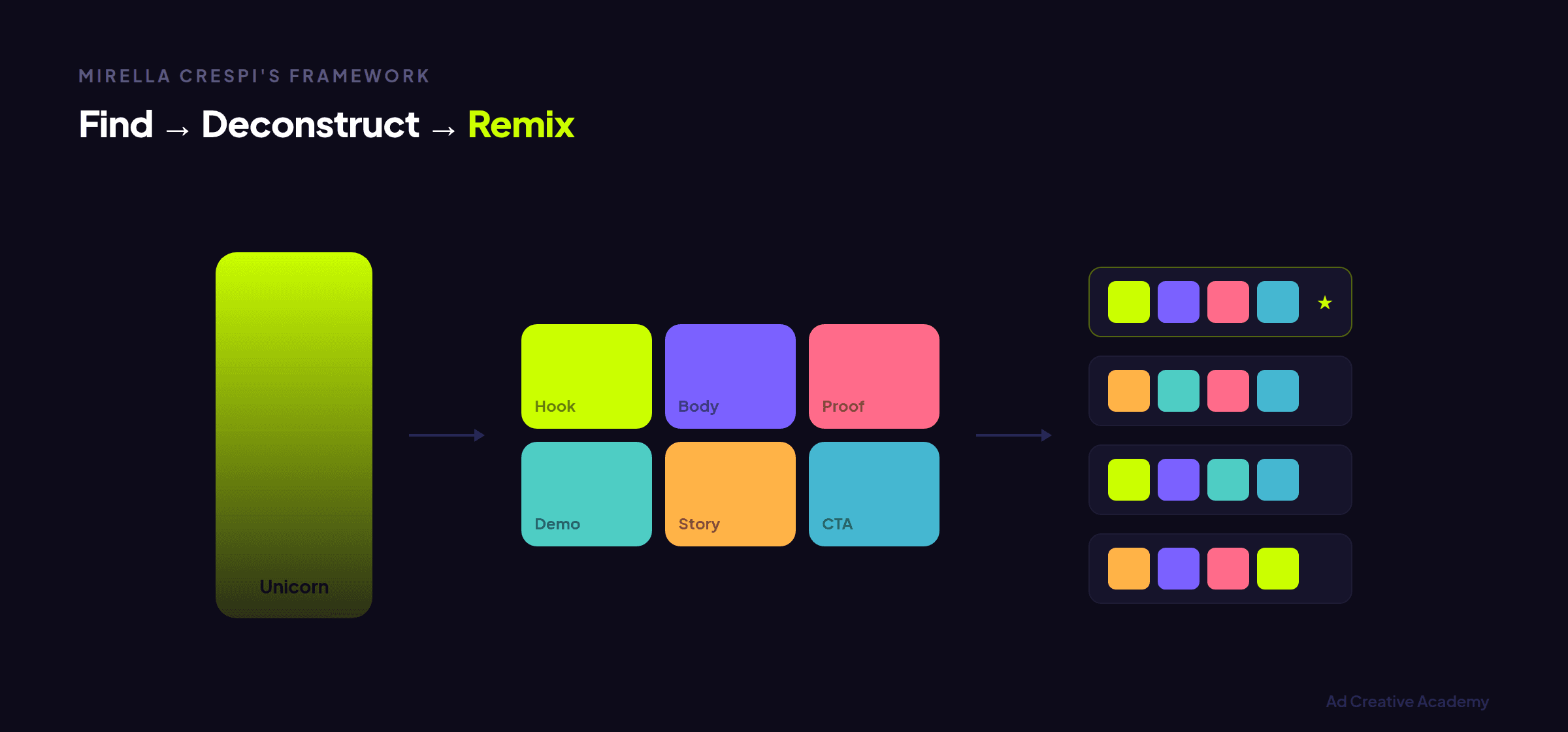
Professor Crespi's Building Blocks framework transforms your Unicorn from a mysterious winner into a replicable system. Instead of seeing your ad as one monolithic piece, you break it down into modular components that can be mixed, matched, and scaled.
The Core Building Blocks
Level 1: Structural Components - Hook: The opening attention-grabber - Body: The main persuasive content - CTA: The specific action request
Level 2: Functional Blocks - Problem blocks: Pain point identification - Solution blocks: Benefit presentation - Proof blocks: Social validation and credibility - Demonstration blocks: How the product works - Storytelling blocks: Narrative and emotional connection
The Deconstruction Process
Take your Unicorn and map each element to its functional purpose. A typical high-performing ad might break down like this:
Hook (Problem block): "Still struggling with back pain after expensive treatments?"
Body (Demonstration + Proof blocks): "This 2-minute morning routine fixed my chronic pain. Over 50,000 people have tried it."
CTA (Solution block): "Watch the free demonstration here"
Now you have ingredients, not just a recipe. Each block can be remixed with different components while maintaining the underlying persuasive structure.
Building Your Block Library
As you identify more winning creatives, expand your block library. Sort them by function and performance. Track which problem blocks resonate most, which proof elements convert best, which demonstration styles engage your audience.
Professor Crespi emphasizes: "If you're a creative strategist, you are the bridge that connects data and creative production. You orchestrate the system and glue it all together."
Your block library becomes the strategic foundation that informs every creative decision.
Step 3: Build Your Testing Hierarchy
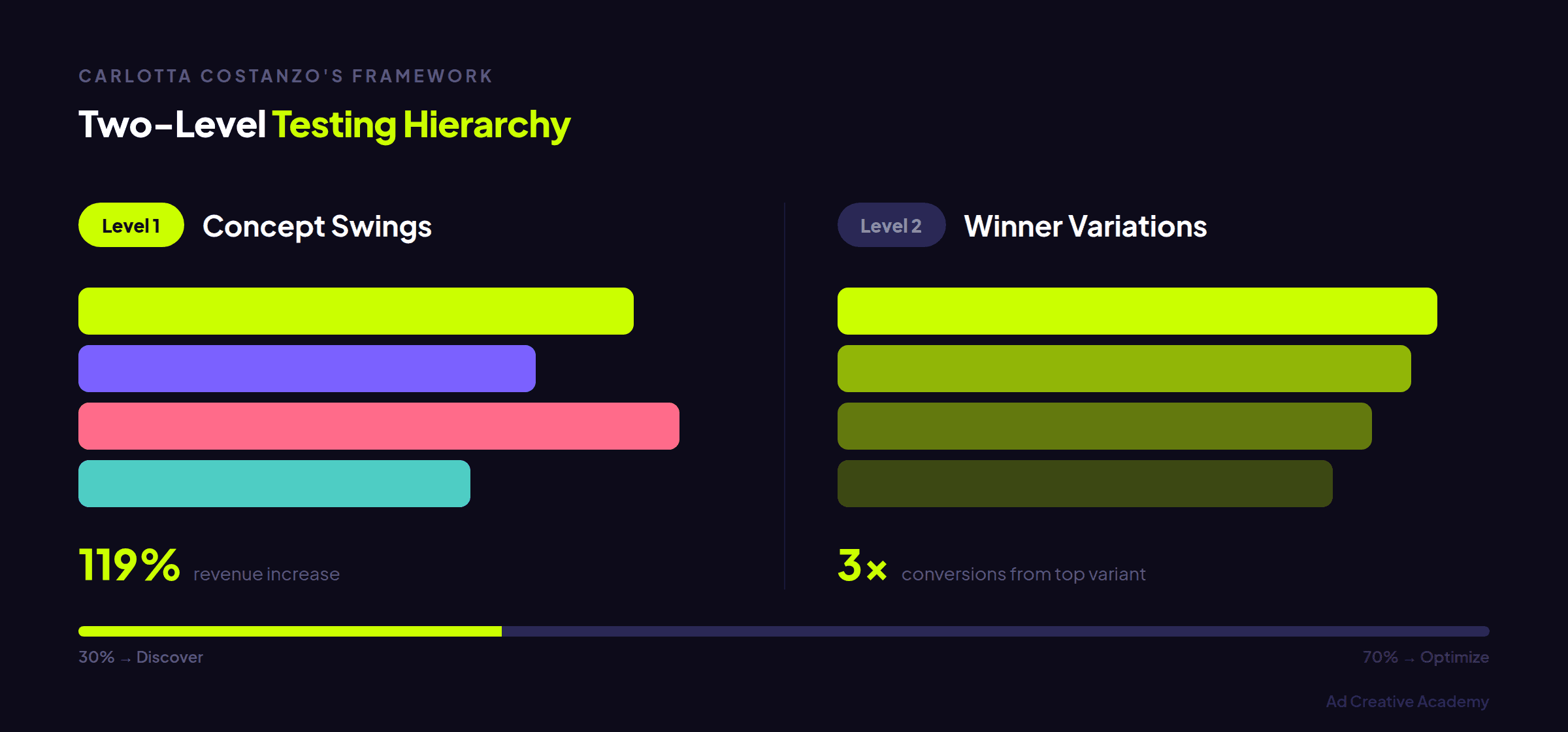
Professor Carlotta Costanzo, who manages over £100 million in media spend, has developed a two-level testing hierarchy that separates big strategic bets from systematic optimizations.
Level 1: Concept Testing
Level 1 tests are big, bold concept swings. You're testing fundamentally different approaches to your core message. These tests have high impact potential but also high resource requirements.
Examples of Level 1 tests: - Problem-focused vs benefit-focused messaging - Educational vs entertainment content styles - User-generated content vs brand-produced content - Static images vs video vs carousel formats
Case Study: A D2C hearables brand Professor Costanzo worked with went from 5 to 20 A/B tests per quarter, scaling from 44 to 120 concepts tested. The result? Revenue jumped 119%, order volume doubled, while maintaining stable ROAS.
The key to Level 1 testing is patience. These tests need sufficient sample sizes and time to reach statistical significance. Run them for minimum 7-14 days with at least 50 conversions per variant.
Level 2: Systematic Variations
Level 2 tests are systematic variations of your Level 1 winners. You've proven a concept works, now you optimize the execution.
Examples of Level 2 tests: - Different headlines for the same concept - Various opening hooks for the same story - Multiple CTAs for the same offer - Different social proof elements
Case Study: Moonbird's testing journey illustrates this perfectly. Their Level 1 test compared static images vs split screen vs iPhone Notes format. The static format with a hand holding the product won with 38% lower cost per acquisition.
For Level 2, they tested headline variations on the winning static format: "Anti-anxiety," "Travel anxiety relief," "Sleep training," and "Focus booster." All performed profitably, but "Anti-anxiety" drove 3x more conversions than the others.
Resource Allocation Strategy
Allocate your testing resources strategically: - 30% of creative budget on Level 1 concept testing - 70% on Level 2 optimization of proven winners
This balance ensures you're discovering new opportunities while systematically improving what already works.
Step 4: Volume, Velocity, Versions
Professor Udi Avital brings a former Meta insider's perspective to creative production. After 9 years reviewing ads at Meta, his core insight is simple: "The companies that dominate today consistently create high volume at high speed in diverse versions. They have built a creative machine and it's hard to beat."
The Three Pillars
Volume: Top advertisers produce 50-100 new ad variations per week, including iterations. This isn't random production. It's systematic exploration of the creative space around your proven concepts.
Velocity: Speed matters because creative fatigue is real. Only 10% of ads last more than two weeks in Professor Avital's analysis. Your production speed must exceed your creative decay rate.
Versions: Diversity within structure. You're not creating random variations. You're systematically exploring different expressions of your proven building blocks.
The Decision Tree
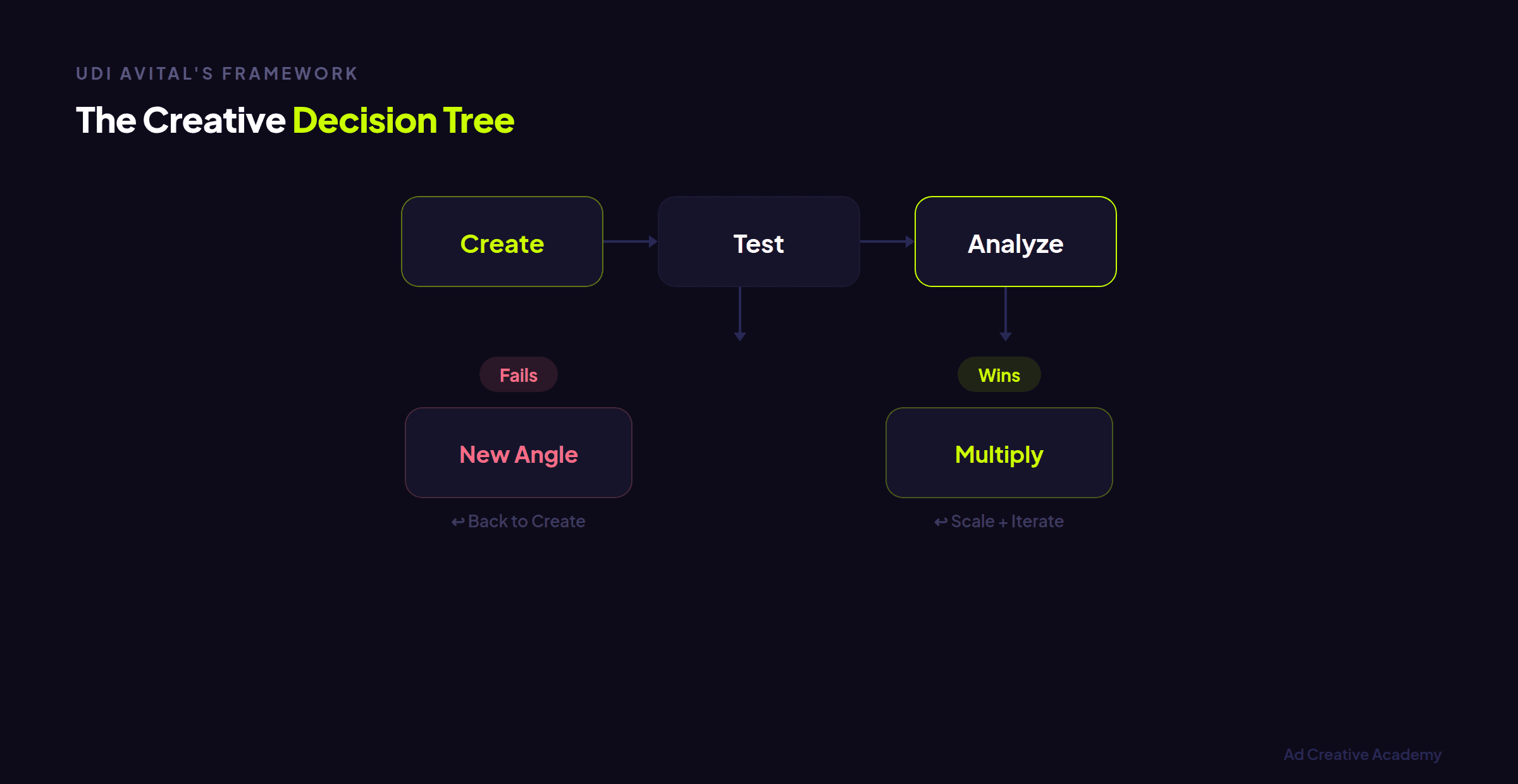
Professor Avital's decision tree provides the operational framework:
Create: New creative based on your building blocks
Test: Launch with sufficient budget for statistical significance
Analyze: Winner or loser?
If it fails: New angle, different building blocks
If it works: Break it down, identify winning elements, multiply variations
Scaling Production
To hit 50-100 variations per week, you need systems, not just talent:
Creative Brief Templates: Standardized briefs based on your building blocks ensure consistency while enabling speed.
Asset Libraries: Stock footage, music, graphics organized by emotional tone and use case.
Production Workflows: Clear processes for ideation, creation, approval, and launch.
Performance Feedback Loops: Real-time data feeds back to inform next week's creative direction.
The goal isn't to produce 100 random ads. It's to systematically explore the creative space around your proven concepts with industrial efficiency.
The Complete System Integration
Now we integrate all three frameworks into a unified creative testing system.
The Strategic Foundation
Start with Professor Crespi's Unicorn identification and building blocks analysis. This gives you the strategic DNA of what works for your brand. Your building blocks library becomes the creative constitution that guides all future decisions.
The Testing Framework
Apply Professor Costanzo's two-level hierarchy to structure your testing approach. Level 1 tests explore new strategic territories. Level 2 tests optimize proven concepts. This prevents you from optimizing mediocre creatives while ensuring you maximize the potential of winners.
The Production Engine
Use Professor Avital's volume, velocity, versions framework to scale systematically. Your building blocks inform what to create. Your testing hierarchy determines how to prioritize. Your production engine ensures you can execute at competitive speed.
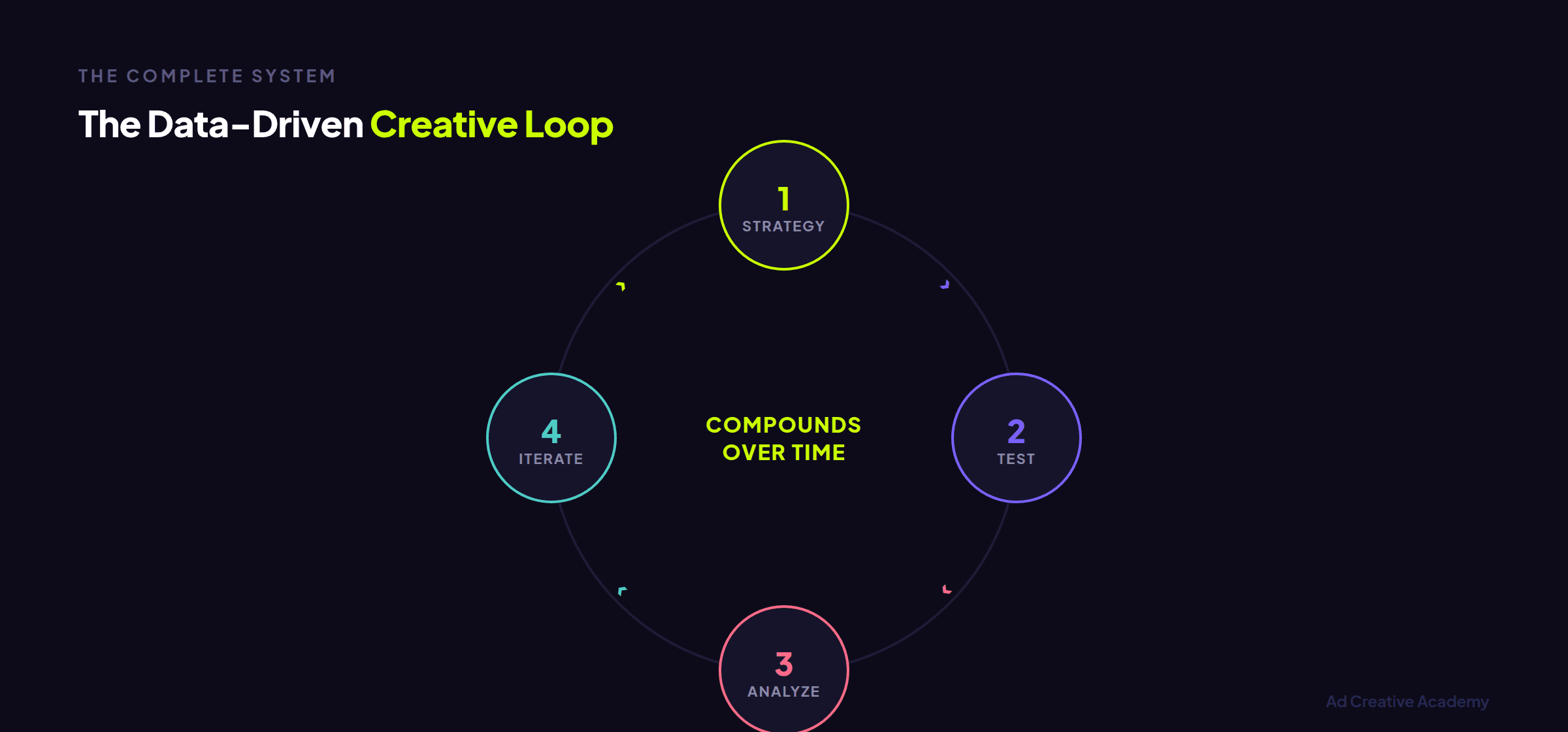
The Data-Driven Loop
Professor Crespi's "Data-Driven Creative Machine" ties everything together: Strategy → Structured Testing → Analysis → Iteration → back to Strategy. This creates a continuous learning loop that compounds over time.
Week 1-2: Identify Unicorn, build initial building blocks library Week 3-4: Launch Level 1 concept tests based on building blocks Week 5-6: Analyze results, expand building blocks with new winners Week 7-8: Launch Level 2 variations of winning concepts Week 9-10: Scale production of proven variations Ongoing: Continuous optimization and strategic expansion
Performance Benchmarks
Track these metrics to ensure your system is working:
Creative Volume: 20+ new variations per week (scale to 50-100)
Test Velocity: New Level 1 tests every 2 weeks
Learning Rate: 1-2 new building blocks identified monthly
Performance: 15+ structured experiments annually
Efficiency: Decreasing cost per creative produced
Effectiveness: Increasing conversion rates over time
Implementation Reality Check
Building this system requires investment. You need creative talent, production resources, media budget for testing, and analytical capabilities. But the alternative is worse: random testing that teaches you nothing and scales poorly.
A B2B services brand that Professor Costanzo worked with doubled their UGC video testing volume in just two months. The result? 83% more qualified leads year-over-year and cost per lead cut in half.
The companies winning at scale aren't necessarily more creative. They're more systematic.
Professor Avital's blunt assessment: "Nobody can predict winners, even after 9 years at Meta reviewing ads." The solution isn't better prediction. It's better systems for rapid testing and scaling of unpredictable winners.
Start Where You Are
Don't wait for perfect conditions. Start with one Unicorn analysis. Build your first building blocks library. Run your first structured Level 1 test. The system improves through use, not planning.
Your creative testing methodology doesn't need to be perfect. It needs to be systematic, scalable, and continuously improving.
The Competitive Advantage
Most brands approach creative testing like gambling. They bet on hunches and hope for luck. But the top 1% treat it like a science experiment. They form hypotheses, test systematically, and compound their learnings over time.
This systematic approach creates a sustainable competitive advantage. Your creative performance improves month over month while competitors stay stuck in random testing loops.
The building blocks you develop become intellectual property. The testing frameworks you build become operational advantages. The production systems you create become barriers to entry.
This is how creative testing becomes a moat, not just a tactic.
The Bottom Line
Creative testing at scale isn't about having endless budget or unlimited creative talent. It's about having better systems.
The Unicorn analysis gives you strategic direction. The building blocks framework gives you reusable components. The testing hierarchy gives you structured experimentation. The production engine gives you competitive velocity.
Combined, these frameworks transform creative testing from random acts of marketing into a systematic machine for discovering, scaling, and optimizing what works.
The brands dominating your space aren't necessarily more creative. They're more systematic about creativity.
This is exactly what we teach at Ad Creative Academy. Our certification program takes you through the complete creative testing system, from building blocks to AI-powered workflows. Enroll at adcreativeacademy.com