


A strong creative strategy portfolio is one of the most powerful career assets a performance marketer can build. Most people are building theirs wrong.
Your portfolio is not a gallery of finished ads. It is proof of how you think: how you research audiences, develop concepts, structure tests, and connect creative decisions to measurable results.
In 2026, creative strategy has become the highest-leverage skill in paid social advertising. After privacy changes reduced algorithmic targeting precision, the creative itself became the primary targeting mechanism. The strategists who can systematically develop high-performing creative are in serious demand.
This guide walks you through exactly what to include in a creative strategy portfolio, 10 formats used by successful strategists, a free template, and the most common mistakes to avoid.
Why You Need a Creative Strategy Portfolio
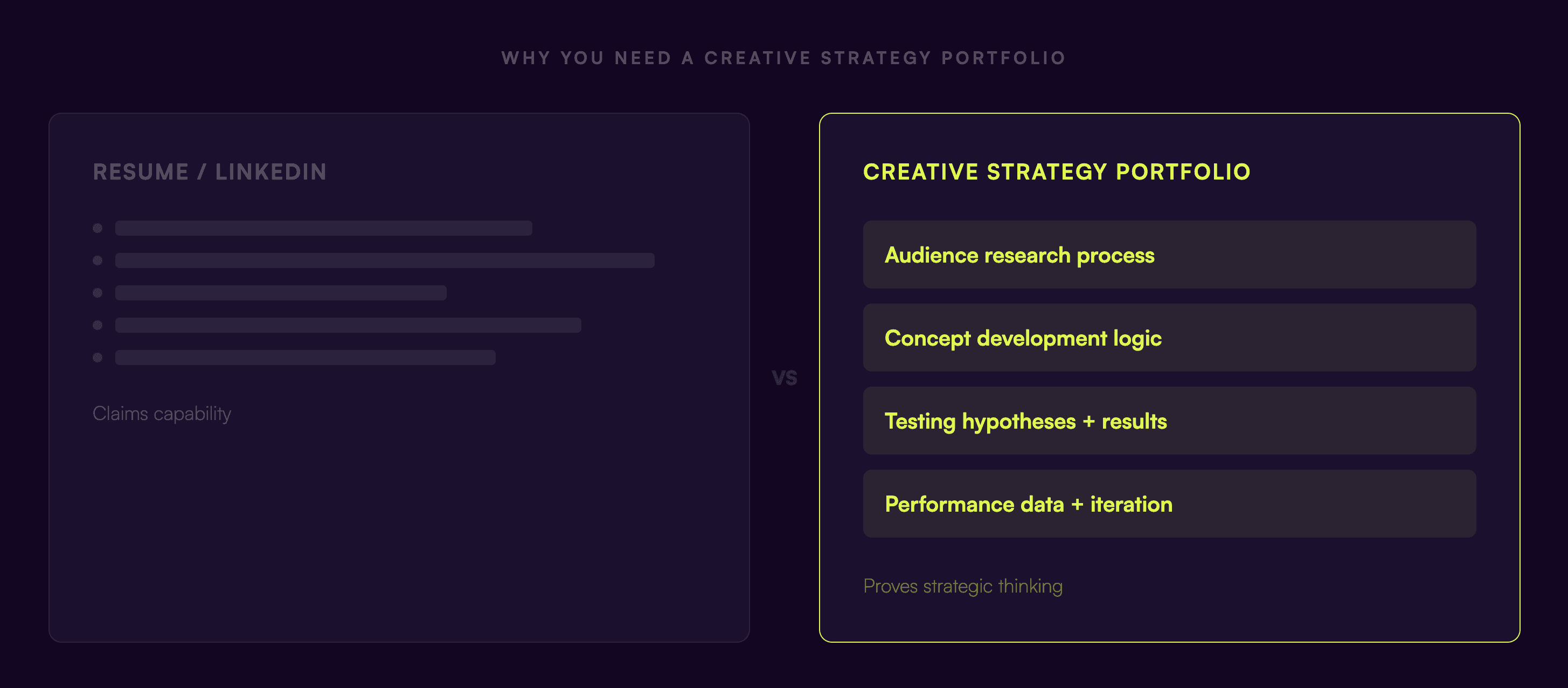
Most marketers rely on a resume or LinkedIn profile. For a creative strategist, that is not enough.
Creative strategy sits at the intersection of performance marketing, consumer psychology, and creative production. Hiring managers and potential clients cannot assess that combination from a bullet point list. They need to see how you connect data to creative decisions.
A well-built creative strategy portfolio demonstrates:
How you research audiences and uncover emotional motivators
How you analyze competitor creative and identify market gaps
How you develop concepts and write scripts grounded in insight
How you structure creative tests and form hypotheses
How you analyze performance data and iterate intelligently
In short, your portfolio is your strategic proof. Anyone can claim they understand advertising. A portfolio shows it.
Creative Strategy Is Now a Core Advertising Skill
The advertising landscape has fundamentally shifted. Platform algorithms now handle much of the bid optimization and audience targeting that marketers once managed manually. Instead, platforms rely increasingly on creative engagement signals to determine which audiences receive which ads.
That shift has elevated creative strategy from a supporting function to the primary growth lever in paid media. Creative quality, not targeting precision, is now the biggest variable determining campaign performance.
Your portfolio should reflect that reality.
Who Needs a Creative Strategy Portfolio
You should be building a creative strategy portfolio if you are:
Applying for creative strategist roles at agencies or in-house brands
Pitching freelance clients for paid social work
Seeking promotion to a senior creative strategy position
Building a personal brand in the performance marketing space
Instead of telling people what you are capable of, your portfolio shows them.
What to Include in a Creative Strategy Portfolio
The most common mistake strategists make is building a portfolio that looks like a design portfolio full of finished creative with no explanation of the thinking behind it. Employers and clients do not need to see polished ads. They need to see your process.
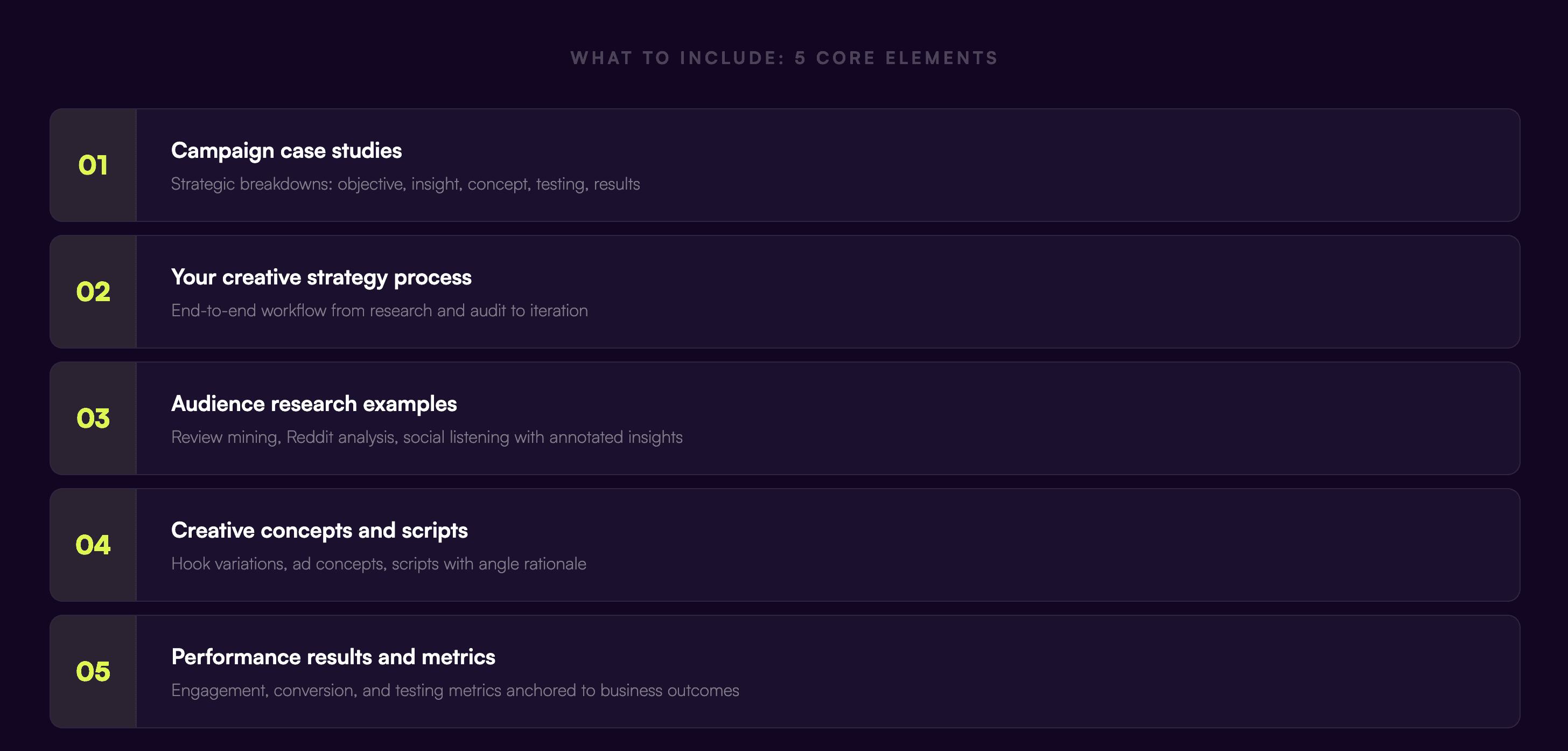
A strong creative strategy portfolio includes five core elements.
1. Campaign Case Studies
Case studies are the foundation of your portfolio. Each one should tell a complete strategic story using a clear structure:
Case Study Structure Business Objective: What were you trying to achieve? Audience Insight: What did you learn about the customer? Creative Concept: What was the strategic idea and why? Testing Strategy: How did you structure the experiment? Results: What happened and what did you learn? |

Example: A DTC skincare brand needed to reduce CPA without increasing spend. Audience research revealed customers believed premium skincare was overpriced. The strategic angle shifted to demonstrating visible results through authentic UGC testimonials. Testing three hook variations and two storytelling formats led to a 38% increase in CTR and a 22% decrease in CPA.
Notice the difference between describing a campaign and explaining the strategic logic behind it. That explanation is what separates a design portfolio from a creative strategy portfolio.
2. Your Creative Strategy Process
Employers want to understand how you approach advertising problems from scratch. Include a section that outlines your workflow end to end.
A strong creative strategy process typically covers:
Ad account audit and performance analysis
Audience research using reviews, Reddit, social listening, and customer interviews
Competitor creative analysis across Meta Ad Library, TikTok, and Google
Trends research and platform-native content analysis
Concept development using the Persona, Motivator, Benefit, Offer framework
Scriptwriting and storyboarding
Structured creative testing with clear hypotheses
Performance analysis and creative iteration
Documenting this process shows strategic maturity. It tells a hiring manager that you do not rely on instinct. You follow a repeatable system.
3. Audience Research Examples
Great creative strategy starts with deep audience insight. Showing how you uncover emotional motivators is one of the most compelling things you can include in your portfolio.
Examples might include:
Amazon or Trustpilot review mining with annotated insights
Reddit and forum thread analysis identifying unspoken frustrations
Competitor ad comment analysis revealing audience objections
Customer interview summaries with direct quotes
The key is not just showing what you found. It is showing how the insight shaped the creative direction. For example: customers buying protein supplements complained about bloating, which led to positioning the product around digestive comfort rather than performance. That insight-to-concept connection is your strategic value.
4. Creative Concepts and Scripts
Creative strategists develop the ideas behind campaigns. Your portfolio should show that ability with concrete examples.
Include:
Ad concept breakdowns with named angles and strategic rationale
Hook variations for the same concept
Full or partial scripts with hook, body, and CTA structure
Storyboards or visual direction notes
A concept should identify: who it targets (Persona), what emotion it activates (Motivator), what it promises (Benefit), and what drives action (Offer). That four-part structure should be visible in every creative concept you include.

5. Performance Results and Metrics
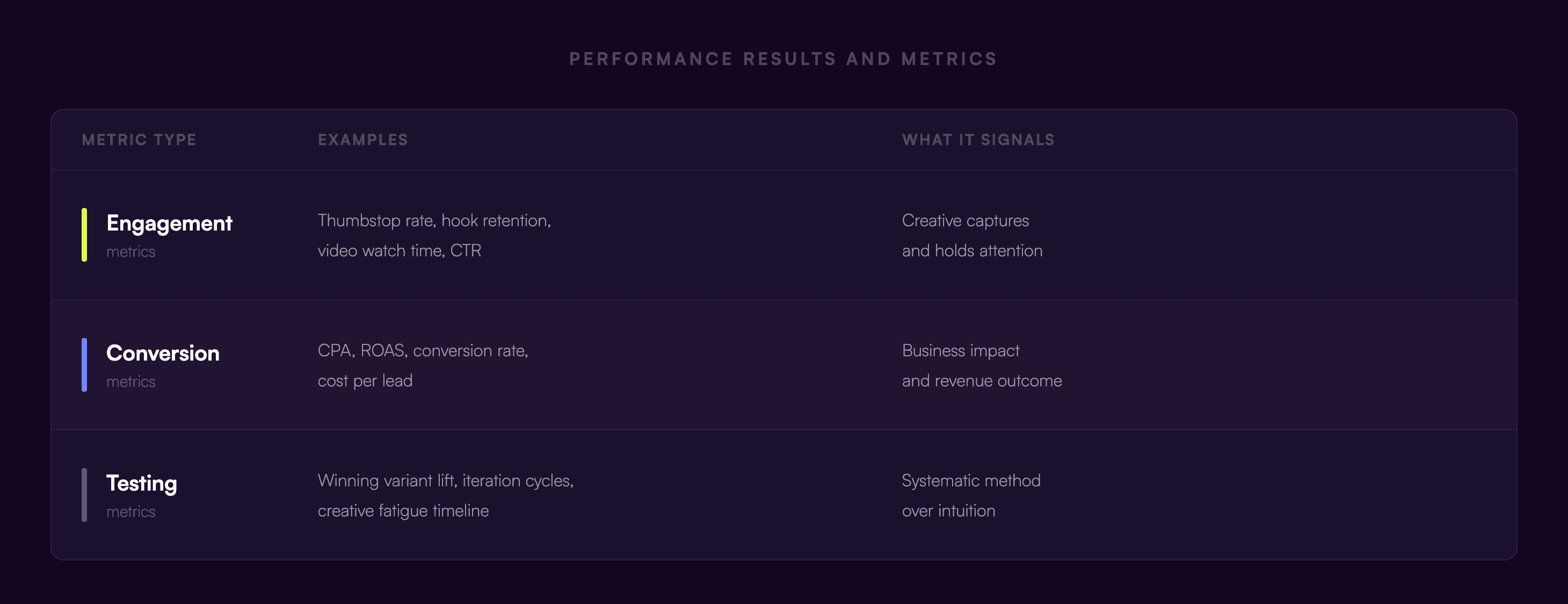
Numbers anchor your portfolio in business reality. Include measurable outcomes wherever possible, even if metrics are approximate or from a smaller test.
Metric Type | Examples |
|---|---|
Engagement Metrics | Thumbstop rate, video watch time, hook retention, CTR |
Conversion Metrics | CPA, ROAS, conversion rate, cost per lead |
Testing Metrics | Winning variant lift, iteration cycle improvement, creative fatigue timeline |
Engagement metrics show whether creative captures and holds attention. Conversion metrics show business impact. Including both demonstrates that you understand the full performance equation.
10 Creative Strategy Portfolio Examples
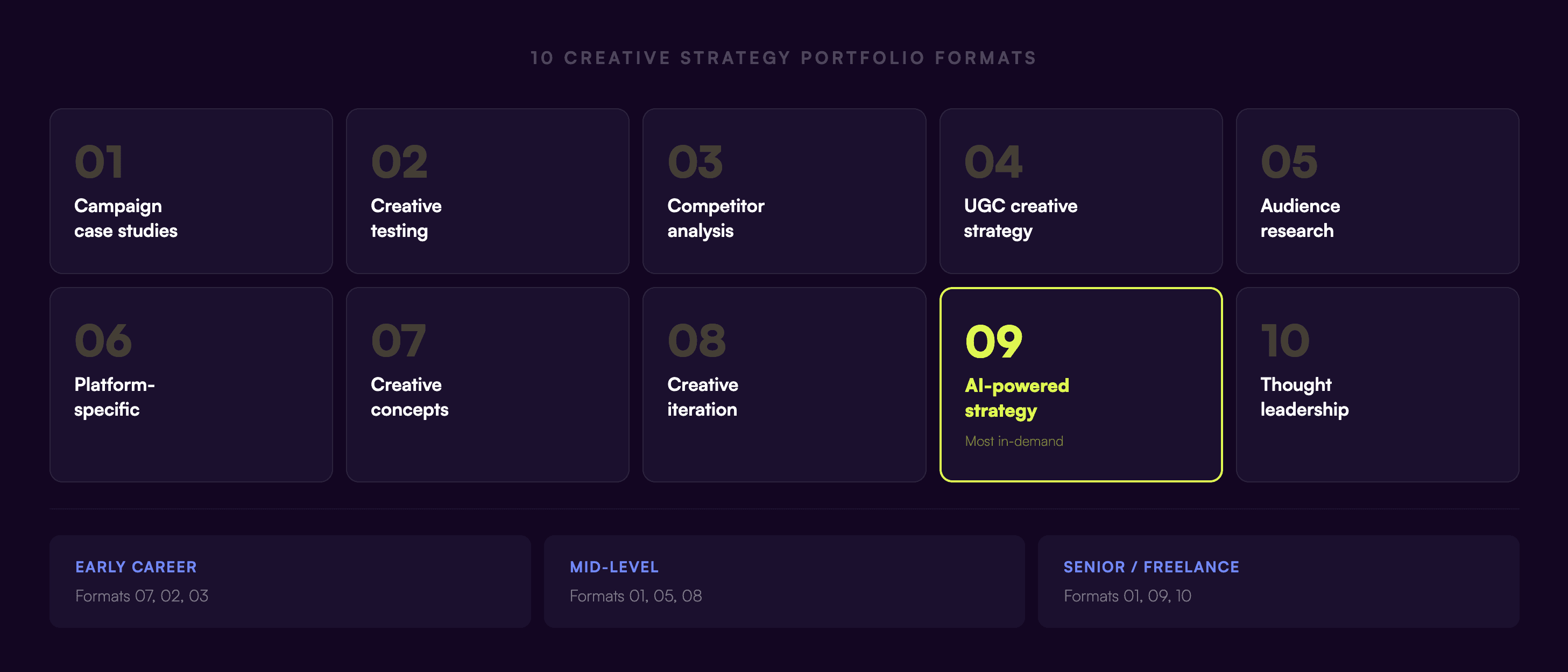
There is no single correct format for a creative strategy portfolio. The right structure depends on your experience, the type of work you are pursuing, and which skills you most want to demonstrate. Here are 10 formats used by successful strategists.
1. Campaign Case Study Portfolio
The most effective format for performance marketers. Center your portfolio around 3 to 5 in-depth campaign breakdowns, each walking through objective, insight, strategy, testing, and results. This format works well for both agency applications and freelance pitches.
2. Creative Testing Portfolio
Focuses on your experimentation rigor. Show the hypothesis, the variables tested, the results, and what you concluded. This portfolio type signals that you run structured tests rather than guessing, which is a valuable differentiator for data-driven teams.
3. Competitor Creative Analysis Portfolio
Demonstrates your ability to read the advertising landscape. Include breakdowns of competitor ads, identification of recurring creative patterns, and your interpretation of what angles are working in a given market. Strong for research-forward strategist roles.
4. UGC Creative Strategy Portfolio
Ideal for strategists who specialize in creator-led content. Showcase creator briefs, UGC concept frameworks, casting direction notes, and scripts written for authentic lo-fi execution. This format is in high demand given how much paid social inventory now runs on UGC formats.
5. Audience Research Portfolio
Positions you as an insights-first strategist. Include annotated research outputs: review mining summaries, social listening reports, market awareness maps, and emotional trigger frameworks. Best suited for senior strategist or planning roles.
6. Platform-Specific Strategy Portfolio
Useful if you want to signal deep expertise in one platform environment. A Meta ads portfolio would emphasize feed, stories, and reels nuances. A TikTok creative strategy portfolio would highlight native content formats, trending sounds, and creator collaboration. Structure each section around how creative requirements differ by platform context.
7. Creative Concept Portfolio
Works well for early-career strategists who may not yet have large campaign results to show. Focus on concept boards, hook libraries, script examples, and messaging frameworks. Include the strategic rationale for each concept to show depth beyond execution.
8. Creative Iteration Portfolio
Shows your ability to learn from performance data and improve. Structure each entry as: original creative, performance analysis, what changed and why, improved creative, results comparison. This format proves you understand that great creative strategy is iterative, not a one-time output.
9. AI-Powered Creative Strategy Portfolio
Increasingly expected for modern strategist roles. Show how you use AI tools across the workflow: research prompts that surface audience insights, AI-assisted concept generation, script iteration using AI, creative analysis tools. This is not about replacing strategic thinking with AI; it is about demonstrating that AI amplifies your strategic output.
10. Thought Leadership Portfolio
Builds reputation through publicly shared ideas. LinkedIn ad breakdowns, creative strategy essays, framework explainers, or short-form video content analyzing what makes specific ads work. Well-known strategists typically combine this with case studies to show both depth of thinking and real-world execution.
Creative Strategy Portfolio Template
If you are building your portfolio from scratch, use a structured template to organize your work clearly. Here is a section-by-section framework:
Portfolio Template Structure Section 1: Introduction Your background, specialization, and what drives your strategic approach Section 2: Your Creative Strategy Framework How you approach advertising problems from research to iteration Section 3: Audience Research Example One detailed research output showing insight development Section 4: Campaign Case Studies (3 to 5) Full strategic breakdowns with objective, insight, concept, testing, results Section 5: Creative Testing Experiments Hypothesis-driven test examples with analysis Section 6: Creative Concepts and Scripts Concepts with full strategic rationale and execution detail Section 7: Performance Results Metrics and business outcomes across your strongest work Section 8: Tools and Workflows The platforms, AI tools, and systems you use to operate efficiently |
Start with your strongest case study. Hiring managers often decide within the first two minutes of reviewing a portfolio whether to continue reading. Lead with your best work.
Consider adding short Loom video walkthroughs to your most important case studies. A two-to-three minute recording of you talking through your strategic thinking gives reviewers more signal than any written document can alone. It also demonstrates the communication skills that are essential in client-facing creative strategy roles.
How to Present Your Creative Strategy Portfolio
The format and presentation of your portfolio matters almost as much as the content. A clear, well-structured portfolio signals the same qualities you bring to creative strategy work: organized thinking, attention to communication, and clarity of message.
Use a Clear Narrative Structure
Every case study should follow a problem-insight-strategy-execution-results arc. This makes your thinking easy to follow and shows that you understand how to tell a story with data, which is exactly what great ad creative does.
Include Visual Breakdowns
Visuals make strategic work easier to absorb. Consider including ad screenshots with annotations, hook comparison matrices showing tested variations, creative testing frameworks laid out visually, and performance trend charts. You do not need a design background to create these. Clean tables and simple charts work well.
Record Short Video Walkthroughs
For your strongest case studies, record a brief Loom video explaining your thinking. Walk through what problem you were solving, what insight shaped your strategy, how you structured your tests, and what you learned. This communicates in minutes what written documents can take far longer to convey.
Keep It Focused
Three to five strong case studies outperform ten mediocre ones. Hiring managers and clients are reviewing multiple portfolios. A tightly curated selection with clear thinking is far more persuasive than a comprehensive archive of everything you have ever touched.
Use Strategic Language Precisely
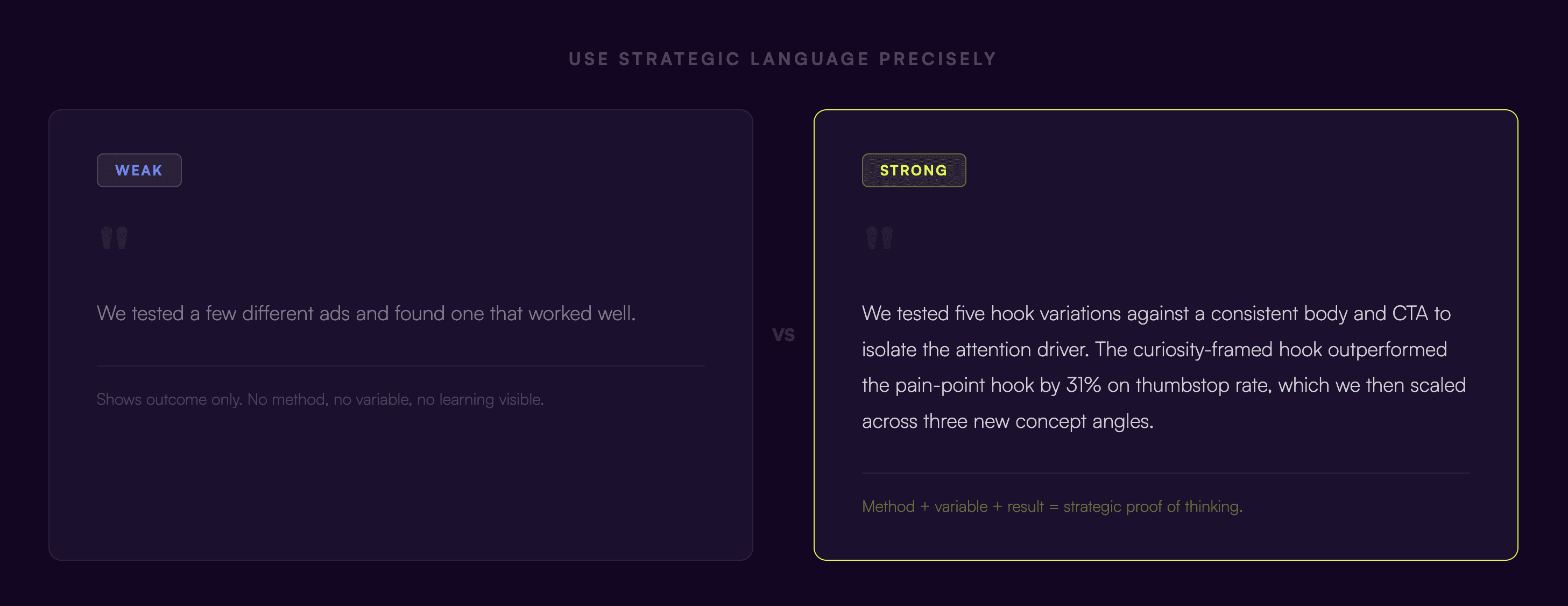
How you describe your work signals your level of expertise. Compare:
Weak: "We tested a few different ads and found one that worked well."
Strong: "We tested five hook variations against a consistent body and CTA to isolate the attention driver. The curiosity-framed hook outperformed the pain-point hook by 31% on thumbstop rate, which we then scaled across three new concept angles."
The second version shows you understand the methodology, not just the outcome.
Common Creative Strategy Portfolio Mistakes
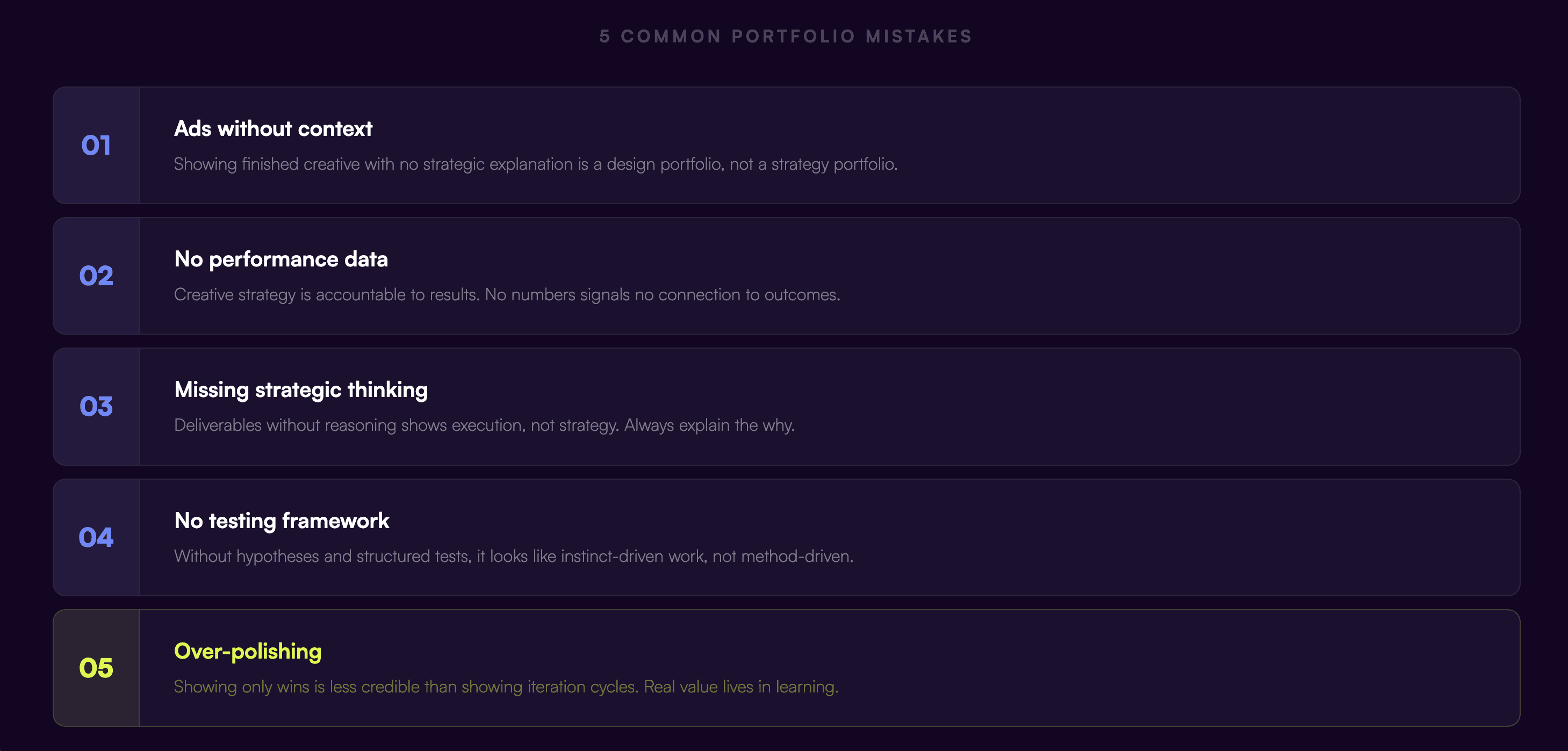
Most portfolio failures come down to the same five issues.
Mistake 1: Showing Ads Without Context
A finished ad with no explanation is a design portfolio, not a strategy portfolio. Every piece of creative in your portfolio needs strategic context: what problem it solved, what insight drove the concept, what the testing hypothesis was, and what results it produced.
Mistake 2: No Performance Data
Creative strategy is accountable to results. If you cannot share exact client metrics due to confidentiality, use approximations, percentage improvements, or describe relative outcomes. No data at all signals that either the work did not perform or you are not tracking the connection between creative decisions and outcomes.
Mistake 3: Missing Strategic Thinking
The most common mistake. A portfolio full of deliverables (briefs, scripts, ad mockups) without any explanation of the strategic reasoning behind them shows execution capability without strategy capability. Always explain why you made the decisions you made.
Mistake 4: No Testing Framework
Modern creative strategy is built on systematic experimentation. If your portfolio does not show how you form hypotheses, structure variable-controlled tests, and iterate based on results, it will look like you are operating on instinct rather than method.
Mistake 5: Over-Polishing
Counterintuitively, overly polished work can hurt your portfolio. Showing a messy iteration cycle (a concept that underperformed, what you learned, and how you adapted) is more credible than only showing wins. Real strategic value is demonstrated through learning, not just success.
Final Thoughts
A creative strategy portfolio is not a collection of ads. It is a demonstration of how you think.
The best portfolios show how audience research, consumer psychology, creative concept development, systematic testing, and performance analysis work together to drive advertising results. That integrated thinking is the skill that makes creative strategists valuable, and it is the skill that a strong portfolio must communicate.
As platforms continue to automate media buying and targeting, creative strategy will only grow in importance. The marketers who can connect data to creative decisions, consistently and systematically, will define the next generation of performance advertising.
If you want to build those skills with a structured curriculum, real frameworks, and instruction from some of the most experienced creative strategists in the industry, Ad Creative Academy is the next step.
Learn how to research audiences, develop high-performing ad concepts, build systematic creative testing frameworks, and leverage AI to amplify your output, in a self-paced certification program designed for working marketers.
Ready to build your creative strategy skills?
Ad Creative Academy is the world's first professional certification for AI-powered creative strategy. Learn from industry experts who have built creative programs at Meta, Google, and TikTok.
Earn your Certified Creative Strategist credential and stand out in the industry. Enroll at adcreativeacademy.com