
Most creative teams blame execution when their ads stop working. Wrong hook. Weak script. Tired format. They brief a new concept, launch it, and wait. The results don't change.
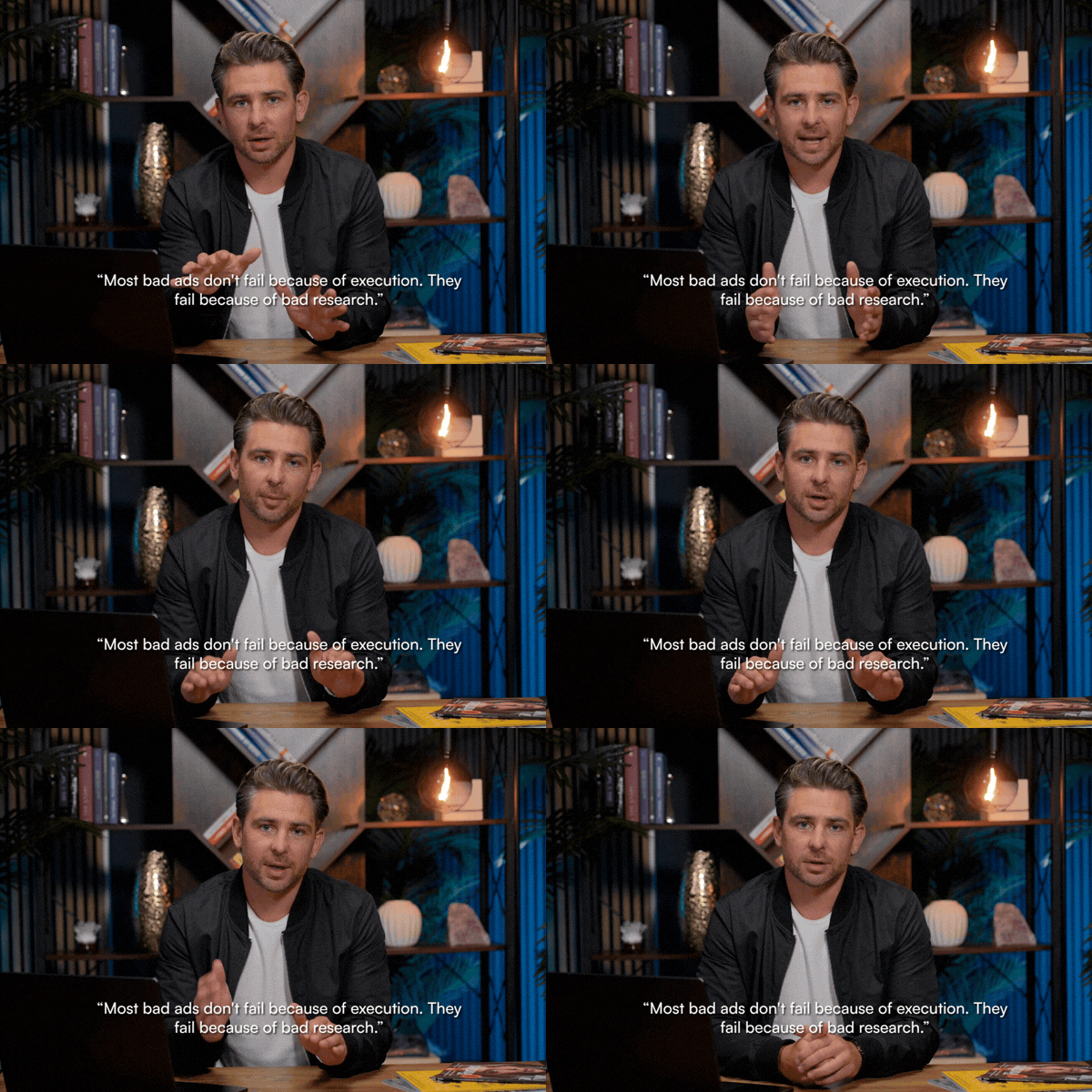
The problem isn't execution. It's that there's no research system upstream of creative production. No structured way to study what's working in the market, capture inspiration across the team, or feed the right inputs into every brief.
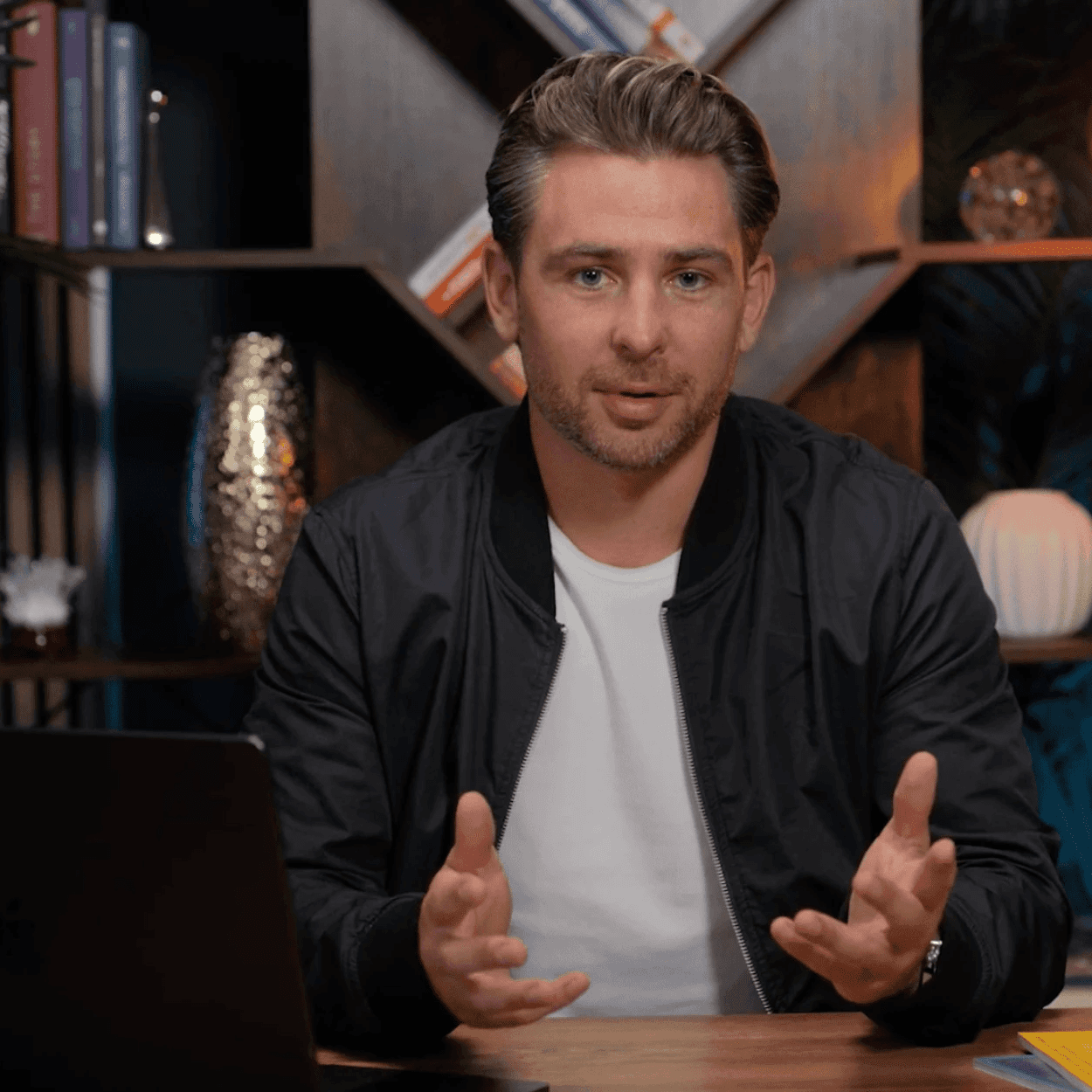
This guide breaks down the ad creative research system taught by Zach Murray, founder of Foreplay, inside Ad Creative Academy's Course 302.
What you'll learn:
Why most ad creative research fails (and what systematic teams do differently)
How to run a structured competitor ad analysis
How to build a team-wide creative research workflow
How to use research inputs to multiply output with AI
Why Most Ad Creative Research Fails
The best-performing creative teams in the world aren't the most talented. They're the most systematic about research.
Most teams "research" competitor ads by scrolling a Facebook page, screenshotting what looks good, and dropping it in Slack. Within 48 hours those screenshots are buried and forgotten. The brief gets written from memory and gut feel.
Systematic teams do something different:
Competitor ad research: Structured audits of hooks, formats, spend signals, and how long ads have been running. Not just what looks polished.
Inspiration capture: A team-wide swipe file with context, tags, and notes. Not screenshots lost in chat.
Brief inputs: Patterns identified from what's actually running and winning. Not what feels fresh to one person.
Performance feedback: Visible to everyone (designers, creators, strategists). Not locked in the media buyer's dashboard.
AI usage: Research-informed prompts that produce differentiated creative. Not generic inputs generating generic outputs.
Meet Zach Murray, Founder of Foreplay
Zach Murray is the founder of Foreplay, one of the world's largest ad creative research platforms. Over 30,000 marketers use Foreplay to save, study, and build ad creative. He built it after running his own DTC brand and living through the exact chaos most creative teams know too well: screenshots in Slack, broken links, half-remembered TikToks, and no centralised place to capture what was actually working.
What he discovered in building Foreplay, and in working with some of the world's biggest performance advertisers, is that the teams consistently producing winning creative aren't the most talented. They're the most systematic.
That insight is the foundation of his Ad Creative Academy module: Course 301: Reverse Engineering Winning Ads: The Creative Research System.
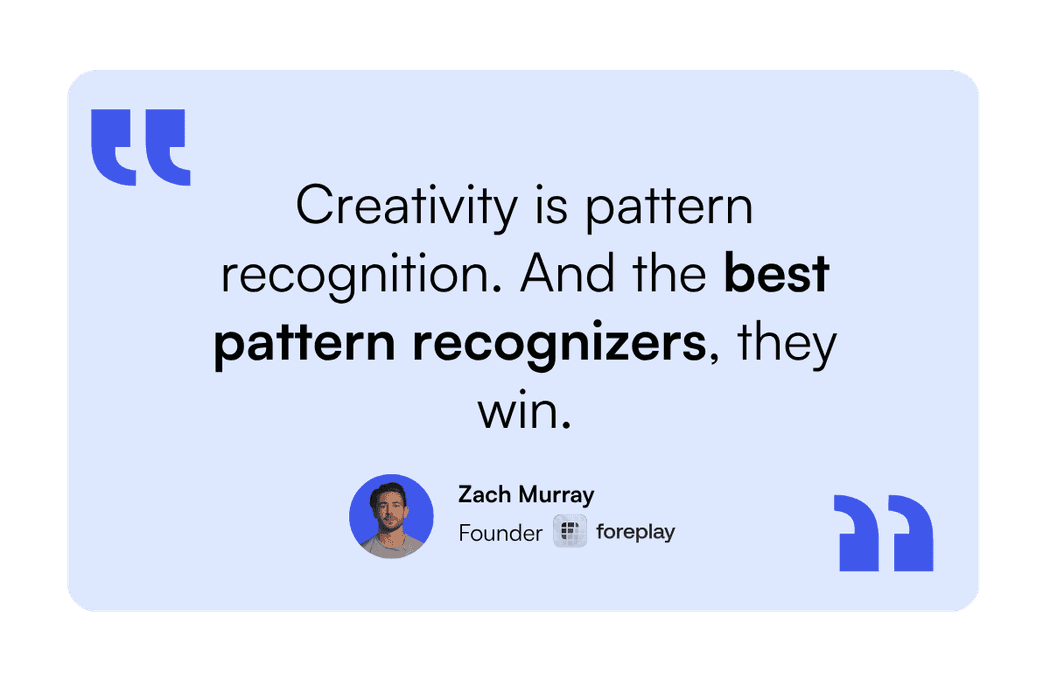
As Zach frames it: creativity is pattern recognition. The teams who win are the ones with the best inputs.
Where most teams go wrong
Area | What most teams do | What systematic teams do |
|---|---|---|
Competitor research | Scroll a competitor's page and note what looks good | Structured audit: hooks, formats, spend signals, longevity |
Inspiration capture | Screenshots in Slack, forgotten in 48 hours | Team-wide swipe file with context and tags |
Brief inputs | What feels fresh to the creative director | Patterns identified from what's actually running and winning |
Performance feedback | Lives with the media buyer, never reaches the team | Visible to everyone, designers, creators, strategists |
AI usage | Generic prompts, generic outputs | Research-informed prompts that produce differentiated creative |
How to Research Competitor Ads Systematically
This is the core of Zach's method, and it's not scrolling ad libraries aimlessly.
Step 1: Identify What's Actually Winning
Not every ad that's running is winning. The key signal is longevity. If two ads from the same brand launched on the same day and one ran for four months while the other disappeared, the long-running ad is your winner.
Tools like Meta Ad Library, Foreplay, and other ad creative research platforms let you track how long ads have been active. Duration beats polish as a signal every time.
Step 2: Break Down the Patterns

Once you've identified winning ads, study the structure, not just the surface. This is where creative strategy frameworks become your diagnostic tool:"
Hook type: Question, bold claim, pattern interrupt, UGC-style opening?
Format: Video, static, carousel? What ratio?
Angle: Pain point, aspiration, social proof, education?
Length: How long are the winners running as content? Short-form or long?
CTA placement: Where and how do they convert?
Step 3: Remix, Don't Copy
There's a meaningful difference between copying and remixing competitor ads. Zach breaks this into two plays:
Single base hits: Take one winning pattern (a hook style, a format) and adapt it quickly for your brand. Fast to execute, easy to test.
Home runs: Take a deeper insight from your competitor ad analysis and build a full creative concept around it. Higher effort, higher upside.
The goal is to steal the structure and apply it with better targeting, better taste, and better timing.
Building a Creative Research System for Your Team

Most creative teams funnel every ad concept through one person. That's a bottleneck and a waste.
Everyone on your team has a completely different algorithm. Your ops person, your customer service rep, your finance lead. They're all seeing ads you'd never encounter. A good ad creative research system captures signal from everywhere.
Here's what that looks like in practice:
Centralised swipe file: One shared location where anyone on the team can save ads they've seen, with context on why it caught their attention, where they saw it, and what brand it's from.
Tagging and categorisation: Tags by format, hook type, industry, angle. This turns a pile of screenshots into a searchable research database.
Regular research sessions: Dedicated time (weekly or bi-weekly) where the team reviews what's been captured, identifies patterns, and feeds insights into upcoming briefs.
Performance as a feedback loop: Make your own ad performance data visible to the entire creative team. When designers and creators can see what's working, the whole team gets smarter, not just the media buyer.
Using AI to Multiply Your Ad Creative Research
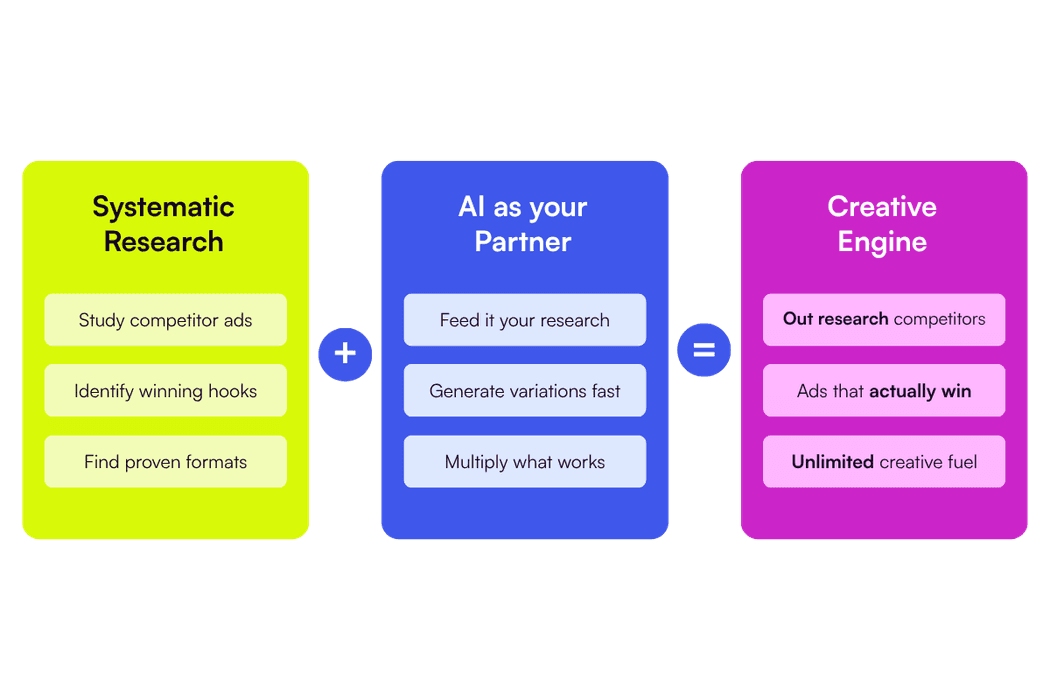
This is where systematic research pays compound returns. Zach calls it becoming a "creative cyborg": someone who combines systematic research with AI as a brainstorming partner.
The difference between generic AI output and useful AI output is the quality of your inputs.
Generic prompt: "Write 5 hooks for a skincare ad"
Research-informed prompt: "Write 5 hooks using the problem-agitation format. The top-performing competitor ads in this space use 3-second hooks that open with a specific skin concern, followed by a surprising stat. Here are 3 examples of hooks that ran for 90+ days: [examples from research]"
The research informs the prompt. The prompt multiplies the output.
For a deeper look at what that means for the role, read what's actually worth $100K in the AI era.
The Competitor Ad Analysis Workflow (Automated)
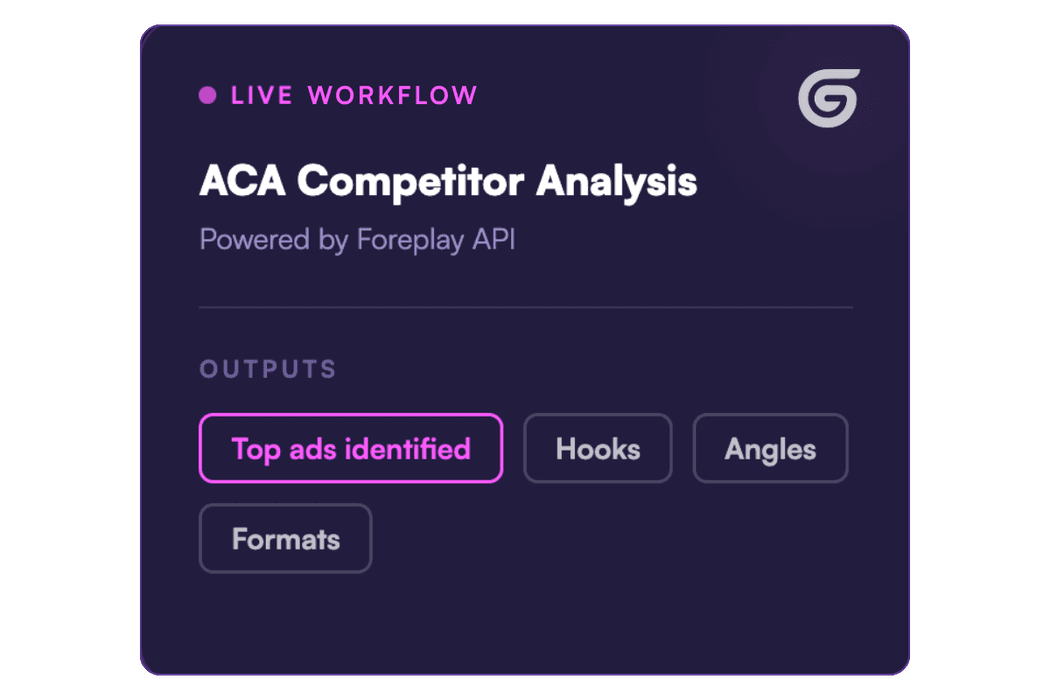
As part of Course 301, ACA students get access to a live Gumloop workflow built on the Foreplay API that automates the research process Zach teaches.
Drop in a competitor brand name. The workflow returns:
Top-performing ads currently identified for that brand
Hooks being used and how long they've been running
Angles and frames appearing most frequently
Formats (video, image, carousel) driving the majority of spend
It takes the competitor ad research process from hours to minutes.
What You'll Walk Away With
By the end of Course 302, you'll have a fully operational research system, not just a framework to think about.
Skill | What it looks like in practice |
|---|---|
Structured competitor audit | Not just scrolling and screenshotting: a repeatable process that surfaces patterns, not noise |
Reading longevity and spend signals | Identify winning ads by how long they've been running, not just how polished they look |
Remixing competitor creative | Turn patterns into original concepts with better targeting and timing than the source |
Team-wide swipe file system | Capture inspiration from every person on the team, not just the creative director's feed |
Performance as a feedback loop | Make data visible to designers and creators, so the whole team learns, not just the media buyer |
Research-informed AI prompting | Use systematic research inputs to multiply creative output with AI: generic prompts out, specific patterns in |
Build Your Ad Creative Research System
Course 302: Reverse Engineering Winning Ads is part of Ad Creative Academy, the world's first AI-powered creative strategy certification.
Zach Murray teaches the full system across three modules:
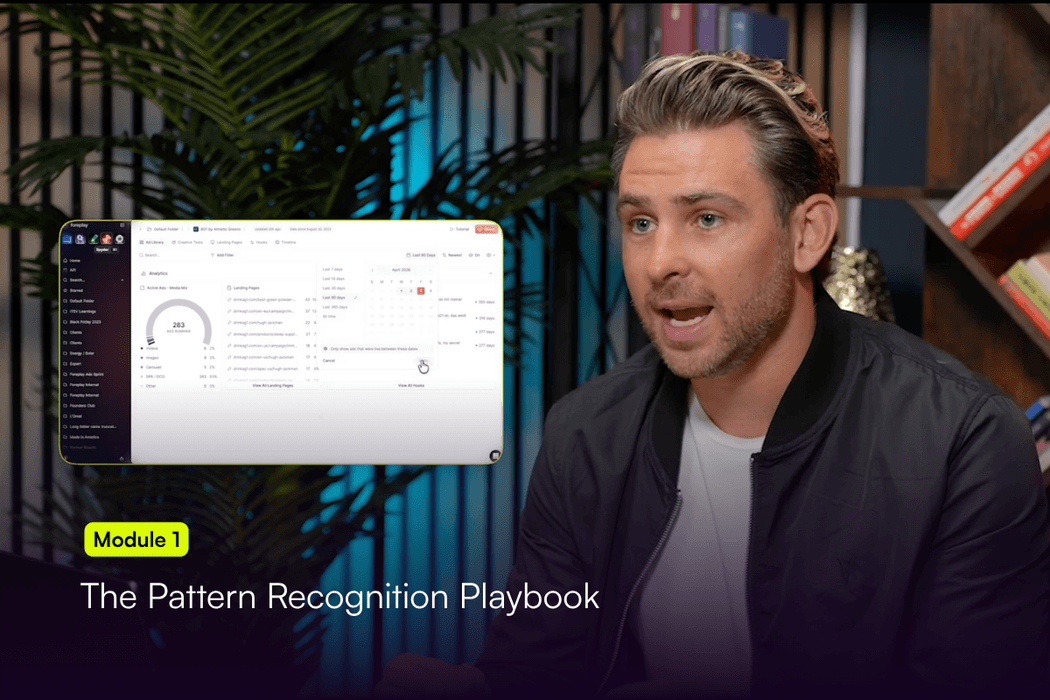
The Pattern Recognition Playbook: Training your eye to identify what's winning and why
The Competitor Audit: A structured ad creative research workflow you can repeat weekly
Building a Creative Engine: Scaling research and inspiration capture across your whole team
New to the role? Start with our guide on what a creative strategist actually does before diving into the research system.
Questions? Email team@adcreativeacademy.com