

Most brands respond to a content plateau the same way. They brief a new concept, try a new format, hire a new creator. The results don't change.
The problem isn't the content. It's what's missing underneath it, a repeatable organic content system that compounds over time.
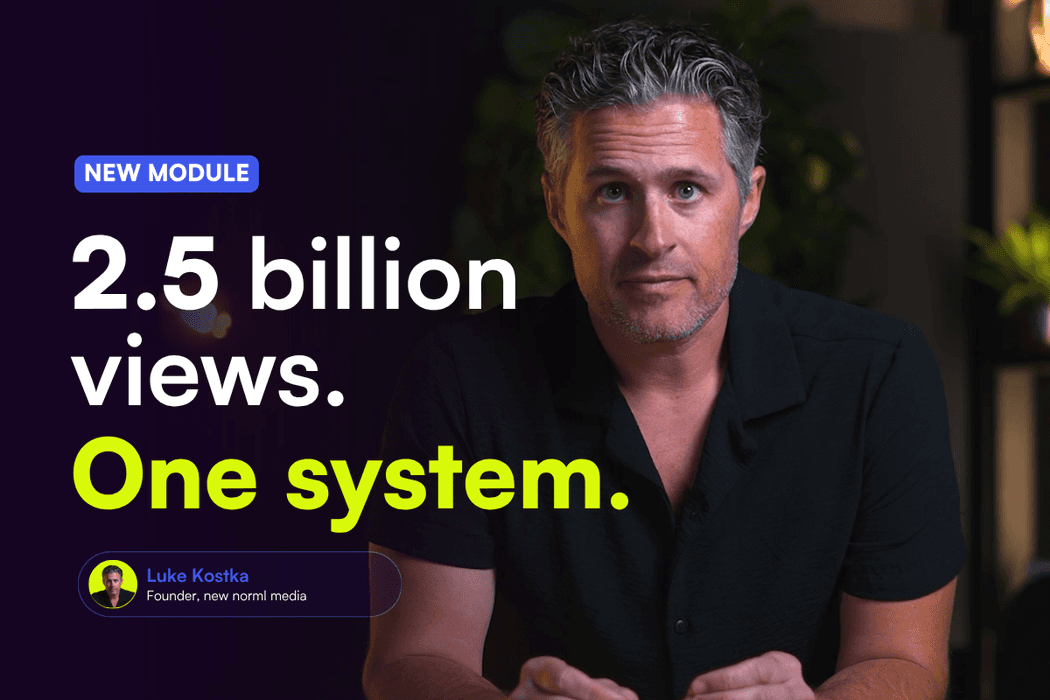
This guide breaks down the framework taught by Luke Kostka, founder of New Norml Media, inside Ad Creative Academy's Billion View Blueprint module.
What you'll learn:
Why most content fails before a single frame is filmed
The three-pillar organic content system behind 2.5 billion organic views
How to test formats the right way and read the data fast
How to build a content machine that runs without burning out
The 60/30/10 content calendar framework used by the world's top-performing B2B brands
Why Most Content Plateaus
Here is how most brands operate. A post goes up. Numbers come in. The team moves on to the next one. There is no feedback loop, no system for reading what worked, and no framework for building on it.
The average human attention span is 7.6 seconds. Gen Z gives you 6.5 seconds per post. TikTok videos under 15 seconds have a 76 percent completion rate. Over 30 seconds, that drops to 42 percent. The drop-off is savage. And 61 percent of users aged 18 to 34 report scroll fatigue, they are scrolling on autopilot.
Your content needs a system to cut through that. Not more posts. A better machine.
What most brands do | What systematic brands do |
|---|---|
Post content and move on | Run a weekly review loop to read what worked |
Brief new concepts when results drop | Test formats 3 to 5 times before judging |
Funnel all ideas through one person | Capture inspiration from every person on the team |
Measure views as the main signal | Track view-through rate, shares, saves, and comment quality |
Post daily with no defined pillars | Build 3 content pillars that give structure without killing creativity |
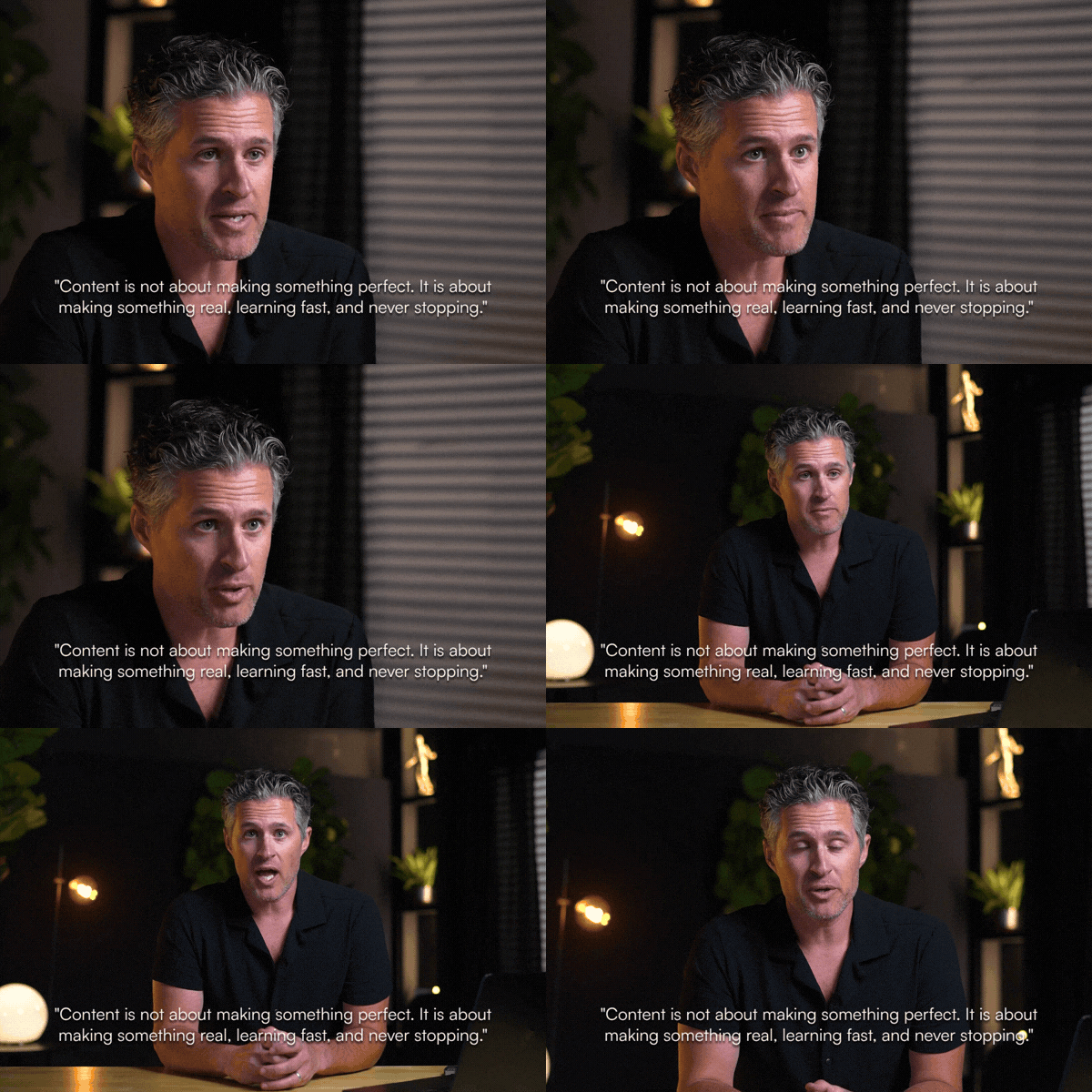
Meet Luke Kostka, Founder of new norml media
Luke Kostka built ClickUp's content engine out of a garage in Dana Point. No massive budget. No viral luck. Just a repeatable organic content system applied consistently.
He took AdLeaks to 50,000 followers. Then AdWorld to 276,000. Then ClickUp found him. He spent three months making videos in a garage, AI tools, a little comedy, fine numbers, nothing breaking through. Then he realised the audience was project managers. He started making content that hit the pain points of project managers and the people who worked with them. Both audiences felt seen.
First video in that format: 10 million views. SNL copied one of his videos. The brand became a meme.
Over four years: 2.5 billion organic views. 2 million followers. 227 million views in a single month. 7,000 videos created.
He is now inside Ad Creative Academy teaching the exact system behind all of it. If you want to make sure the Academy is right for you, The Ad Creative Academy Review 2026 breaks down the full curriculum, faculty, and what the certification is worth.
The Three-Pillar Organic Content System
The framework is built on three pillars. Every brand that has ever compounded its way to scale is operating from all three.
Pillar 1: Resources
Do you have the right gear, people, scripts, and process? Most brands hand an iPhone to an intern and say make us viral. That is a lottery ticket, not a strategy.
Resources covers five roles every content machine needs: the Strategist, the Writer, the Talent, the Editor, and the Publisher. One person can wear multiple hats, but every hat needs to be worn. The Strategist role is more defined than most people realize, A Day in the Life of a Creative Strategist at Meta breaks down exactly what that role looks like from data pulls to briefs.
It also covers scriptwriting, the number one skill in content. When the brain hears facts, two regions activate. When it hears a story, the entire brain lights up and releases dopamine for focus, oxytocin for trust, and endorphins for emotional connection. A well-scripted story hacks brain chemistry. Equipment is a tool, not a strategy. Scriptwriting is the strategy. For the frameworks behind strong creative, 21 Creative Strategy Frameworks Used by Top Brands covers the structures that translate across paid and organic.
Pillar 2: Experimentation
One post is a coin flip. Five posts is data.
The Spaghetti Season is the framework for testing content formats the right way. Try things that might not work. Try them at least three to five times before judging. After five posts, check three metrics against your baseline: view count, watch-through rate, and engagement. Two above baseline? Keep it. All below? Kill it. The same testing discipline applies in paid creative, How to Build a Creative Testing System That Actually Scales covers the full methodology.
Professor Jonah Berger at Wharton studied 7,000 articles and found that high-arousal emotions, awe, excitement, even anger, drive significantly more sharing than low-arousal ones. Bold content triggers high arousal. Safe content triggers nothing. Playing it safe is the riskiest strategy of all.
Pillar 3: Consistency
Content compounds. Teens toggle between apps every 44 seconds. The brands that show up in more micro-sessions win. Volume is not just experimentation, it is mental real estate.
The 60/30/10 content calendar keeps the organic content system running: 60 percent planned content from proven formats, 30 percent experimental, 10 percent reactive, trends, memes, and brainstorm moments. Whatever cadence you pick, sustain it for 90 days. The compound effect takes time. Most brands quit right before it kicks in.
The brands that do build systems at this level are operating what Mirella Crespi calls a creative operating system, What Is the Growth Creative Operating System explains how that works at scale for brands like Canva and American Express.
What's Inside the Module
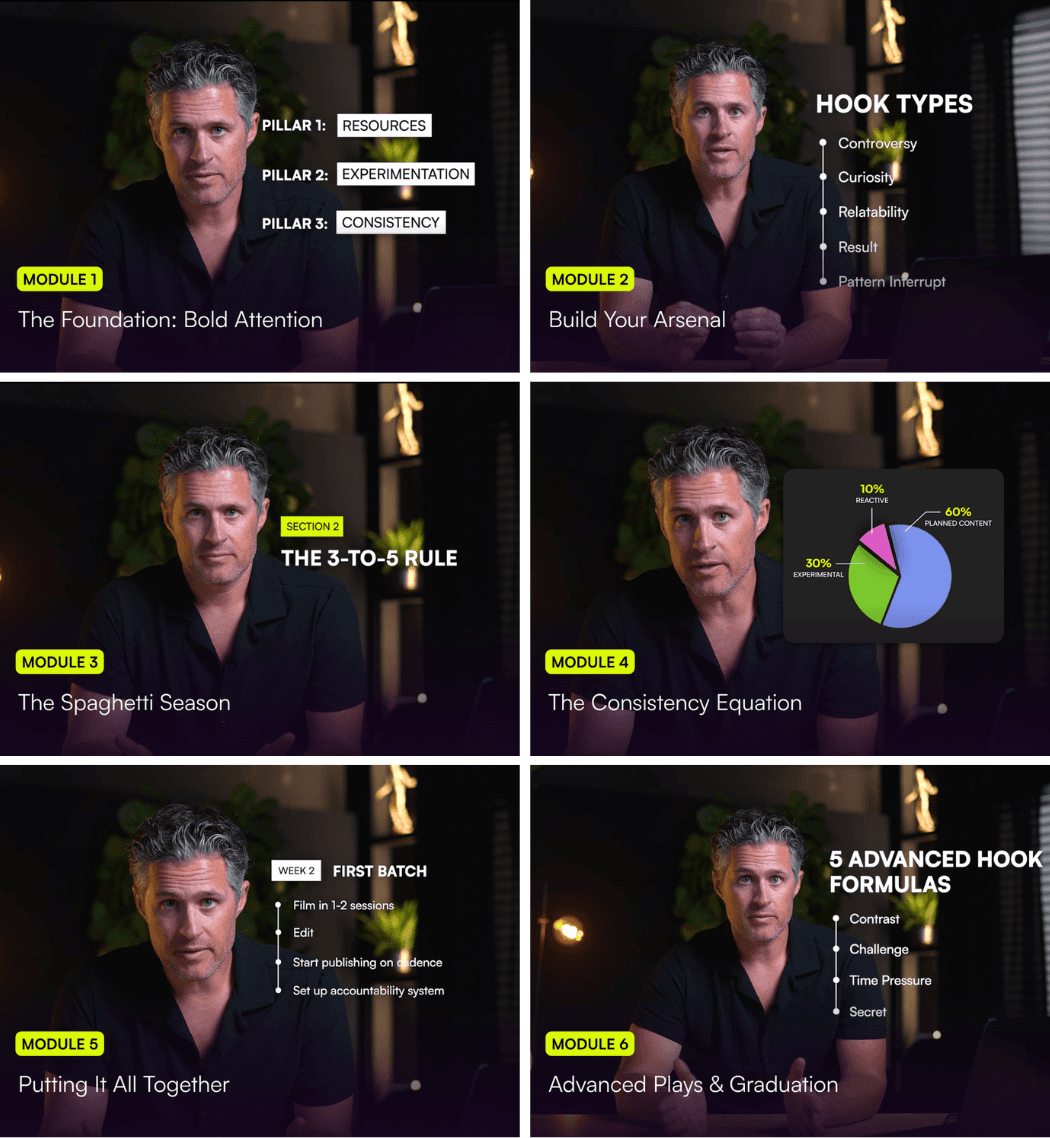
Module 1: The Foundation: Bold Attention
Why most content fails before a single frame is filmed, and the three-pillar organic content system that fixes it. Includes the Content Machine Audit — a five-area baseline assessment covering platform presence, output volume, team roles, production process, and results.
Module 2: Build Your Arsenal
Gear, team, scripts, and a production process that runs every week without burning out. Covers the five content roles, the Hook-Body-Close scriptwriting framework, and the spontaneous content principle — how a 15-minute brainstorm produced a 120 million view video.
Module 3: The Spaghetti Season
How to test formats the right way, and know what to kill, keep, or double down on. Includes pattern interrupt strategy, the 3-to-5 Rule, four metrics that actually matter when reading data, and platform-native adaptation across TikTok, Reels, YouTube Shorts, and LinkedIn.
Module 4: The Consistency Equation
The publishing cadence, accountability systems, and weekly review loop that compounds over time. Includes the 60/30/10 content calendar template and a 30-minute weekly review process that turns every post into a lesson.
Module 5: Putting It All Together
The weekly workflow, the full ClickUp case study mapped across four phases, and a 30-day launch plan. The organic content system is not SaaS-specific — the same framework has been applied across fitness, food, finance, and e-commerce at New Norml Media.
Module 6: Advanced Plays and Graduation
Hook science, three short-form storytelling frameworks, and the Shedding Layers philosophy. Includes five advanced hook formulas and a pattern recognition exercise using real videos, training the instinct that separates content operators from content creators.
Reading the Data Fast
Four metrics matter inside an effective organic content system. Everything else is vanity.
View-through rate is the most important. Under 40 percent means weak hooks. Over 60 percent means strong. Over 80 percent signals a potential viral format.
Shares are the most underrated metric. A share means someone put their name on your content. That is algorithmic gold.
Saves signal high value and are weighted heavily on Instagram and TikTok.
Comments, quality, not quantity. Debates, stories, and tags drive push. Noise does not.
You should know if a post is performing within two hours. The data is there fast. Read it fast.
The Proof
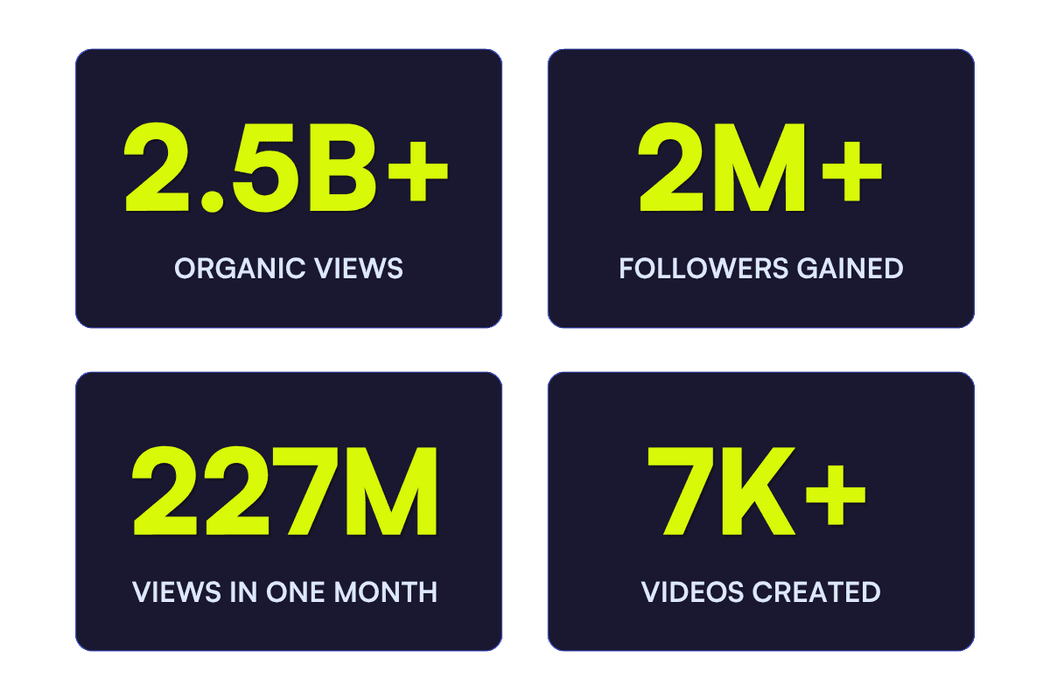
No viral luck. No massive budget. Just a repeatable organic content system applied consistently, and these are the numbers it produced.
A garage in Dana Point. One repeatable system. 2.5 billion views later — now it's yours.
What You'll Walk Away With
Skill | What it looks like in practice |
|---|---|
Three-pillar organic content system | A repeatable framework built around Resources, Experimentation, and Consistency |
3-to-5 Rule | A format testing protocol that prevents quitting too early or holding on too long |
60/30/10 content calendar | A weekly planning system that balances proven formats with experimentation |
Five content roles | A team structure that works whether you are solo or managing a team |
Hook-Body-Close framework | A scriptwriting system grounded in brain chemistry and attention science |
Weekly content review | A 30-minute loop that turns every post into a lesson for the next one |
Frequently Asked Questions
What is an organic content system?
An organic content system is a repeatable framework for planning, producing, testing, and optimizing content without relying on paid distribution. Rather than treating each post as a standalone bet, a content system creates a feedback loop — where each piece of content teaches you something that improves the next one. The three-pillar framework taught in the Billion View Blueprint covers Resources, Experimentation, and Consistency.
How long does it take for a content system to start compounding?
The compound effect in content typically takes 90 days of consistent publishing to become visible in the data. Most brands quit right before it kicks in. The 3-to-5 Rule means no format should be judged before it has been tried at least five times. Consistency, not virality, is the mechanism behind compounding growth.
What is the 60/30/10 content calendar?
The 60/30/10 content calendar is a planning framework that allocates 60 percent of content slots to proven formats from your defined content pillars, 30 percent to experimental formats being tested for the first time, and 10 percent to reactive content, trends, memes, and brainstorm moments. It keeps the organic content system running without burning out the team or stalling on safe content.
Does this organic content system work for B2B brands?
Yes. The framework was built inside ClickUp, a B2B SaaS brand, and produced 2.5 billion organic views over four years. The system has since been applied across fitness, food, finance, and e-commerce brands at New Norml Media. The pillars, cadence, and testing framework apply regardless of industry.
What's the difference between content volume and content quality?
Volume and quality are not in opposition inside a well-built content system. The 3-to-5 Rule uses volume to generate data, which then informs quality decisions. Brands that only pursue quality without volume produce too few posts to identify what's actually working. Brands that only pursue volume without a feedback loop plateau quickly. The weekly content review is the mechanism that connects both.
Build Your Organic Content System
The Billion View Blueprint is part of Ad Creative Academy, the world's first AI-powered creative strategy certification. The module covers six modules across 23 lessons, each under 10 minutes. Every lesson ends with a hands-on challenge.
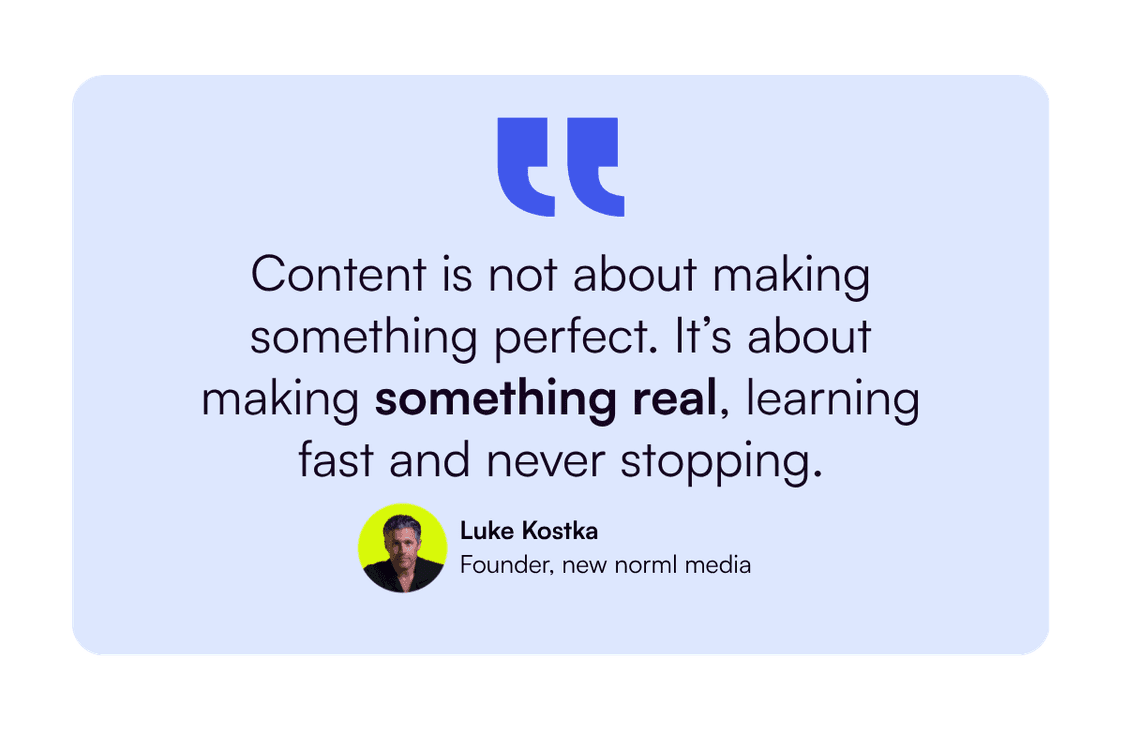
"Those moments are waiting for you. The system makes sure you are ready when they come."
Posting without a system is a bet. This module teaches you to build instead.
Enroll in Ad Creative Academy →
Questions? Email us team@adcreativeacademy.com