

By Mirella Crespi, Head of Faculty at Ad Creative Academy
I've been sitting with a question for months that I think every creative strategist needs to confront honestly: what is the actual value of a human mind when AI can do most of what we used to call "the job"?
Not the polished conference answer. Not "AI is just a tool." The real, uncomfortable version.
Because if we're being honest, the comfortable talking points aren't holding up anymore. AI isn't coming for creative strategy. It's already here, and it's already doing large parts of the work faster, cheaper, and at a scale no human team can match.
If you're still getting oriented on what a creative strategist actually does day-to-day, start with our complete career guide. This piece assumes you already know the role. What I want to explore is whether the role, as we've known it, still makes sense.
What I Watched an AI Do in 20 Minutes
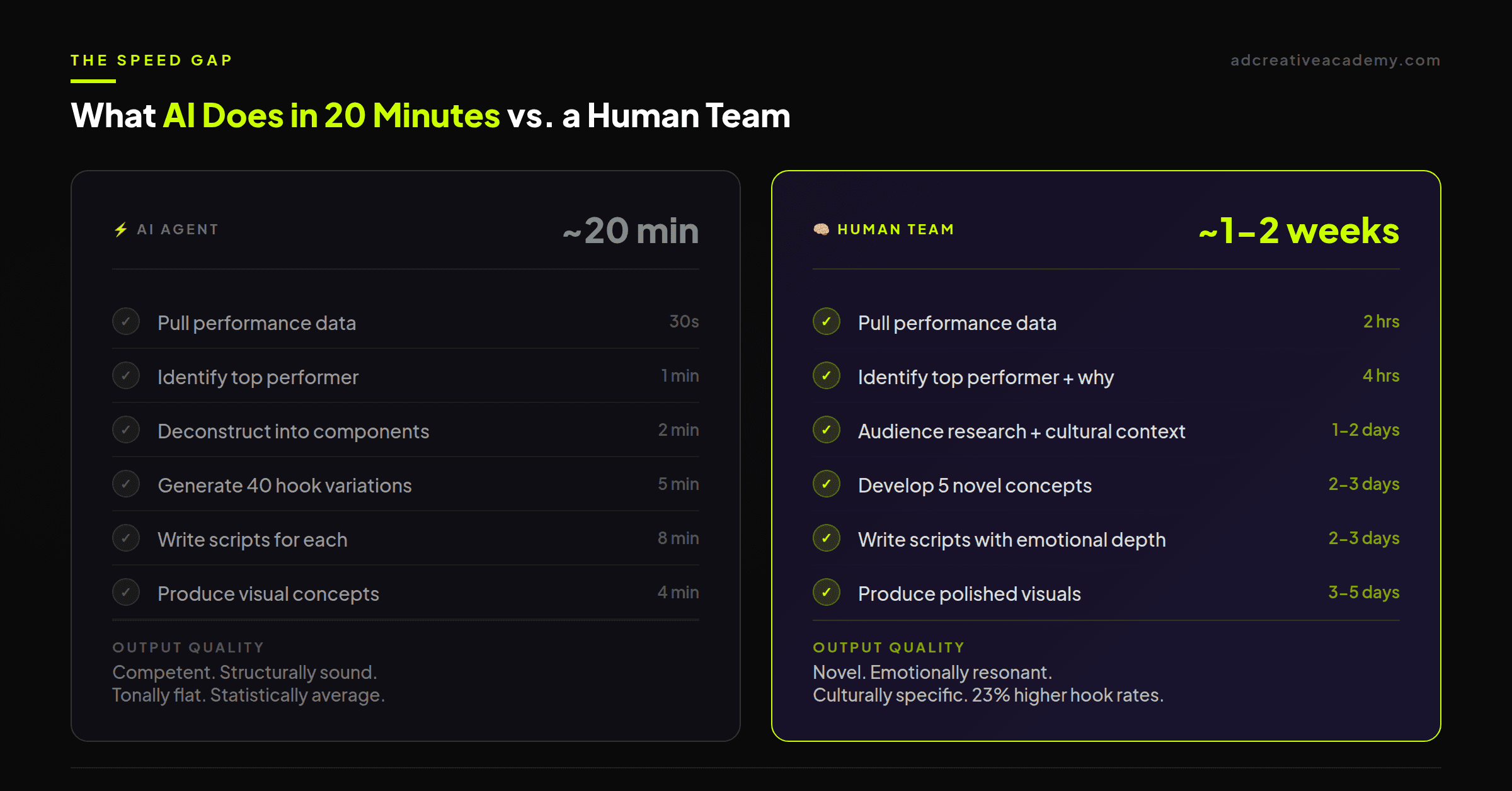
A few weeks ago, I ran an experiment. I gave an AI agent access to an ad account and asked it to do what a junior creative strategist would do in their first week.
It pulled the performance data. Identified the top performer by sustained ROAS. Deconstructed it into modular components: hook type, body structure, CTA framing, proof elements, visual style. Then it generated 40 variations with different hooks, wrote scripts for each one, and produced visual concepts.
Twenty minutes. Maybe less.
A human team would need a week for that scope. Maybe two if the designer is busy.
And it wasn't bad work. The scripts were structurally sound. The hooks were varied. The visual direction was coherent. If I'd received this as a deliverable from a freelancer, I wouldn't have flagged quality issues.
That's the part that should make every creative strategist uncomfortable. Not that AI is producing garbage that's easy to dismiss. It's producing competent work at a pace and cost that fundamentally changes the economics of our industry.
The $100K Question Nobody Wants to Answer
Let's put real numbers on this.
A senior creative strategist in the US earns $100,000 to $150,000 a year. With benefits, that's closer to $130,000-$195,000 in total cost to the company. For that investment, you get one person who can analyze data, develop hypotheses, write briefs, direct creative production, and iterate based on performance.
An AI agent subscription costs a few hundred dollars a month. For that, you get a system that can do the data analysis, variant generation, script writing, competitive scanning, and format adaptation parts of the job. Not all of it. But a significant portion.
Motion is already selling AI Creative Strategists as a product. You can chat with an AI agent named Barry about your ad performance. It analyzes your creative library, identifies patterns, and gives you recommendations. It costs less per month than most strategists charge per day.
Meta is building toward a "goal-only" ad system where you provide a URL and a budget, and the AI handles targeting, bidding, creative generation, and optimization. Google is doing the same. TikTok is doing the same.
So the honest question is: if the execution layer of creative strategy can be automated for a fraction of the cost, what exactly are you paying a human $100K+ to do?
What AI Already Replaced (While We Were Debating Whether It Would)
Here's what happened while the industry was having panel discussions about AI being "a tool, not a replacement."
The junior creative strategist who spent their days pulling reports from Ads Manager, writing briefs from templates, and producing cookie-cutter ad variations? That job is functionally gone. Not going. Gone.
Rory Flynn, who teaches AI workflows at Ad Creative Academy, started with 90 clients and used AI to achieve a 65% reduction in both cost and hours for asset creation. That's not a marginal efficiency gain. That's a structural shift in what a creative team looks like.
The numbers across the industry tell the same story:
AI-assisted creative workflows are roughly 3x faster on average
Copywriting from first draft to final: 4x faster
Strategic research from brief to insight synthesis: nearly 6x faster
Creative production costs: down 28% when AI is properly integrated
A/B testing volume: up over 400% because generating variants costs almost nothing
Average ad lifespan on Meta: down to 4.2 days (from 6.4 in 2024)
That last stat matters. Creative fatigue is accelerating because everyone now has access to AI-powered production. The market is flooded with competent, AI-generated creative. Which means competent isn't enough anymore.
Jesse Ketonen, co-founder of Shook and AI instructor at Ad Creative Academy, framed it precisely: "AI will empower Creative Strategists to play a larger and more impactful role in designing and overseeing creative operations, with fewer resources."
Fewer resources. That's the part people gloss over. Fewer people, doing more work, because AI handles the execution layer.
The 90% Stat That Changes Everything
But here's where the story pivots.
RocketShip HQ analyzed their top 5% of creatives by ROAS across 40+ app clients. Over 90% were conceptualized by a human strategist who then used AI to accelerate execution.
The AI-generated concepts weren't bad. They were just... expected. Statistically optimized averages of what already existed.
Let that sink in. The ads that actually moved the needle, the breakout creatives that 10x'd an account, weren't the ones the algorithm would have suggested. They came from somewhere else entirely. From creative risk. From cultural intuition. From a strategist who understood not just what people click on, but what they secretly want.
When RocketShip A/B tested fully AI-generated persona scripts against human-written ones across 12 subscription app campaigns, the human scripts had 23% higher hook rates in the first 3 seconds. The AI scripts were grammatically perfect and structurally sound. They were also tonally flat.
There's a pattern here. AI excels at producing work that's technically correct and strategically defensible. What it struggles with is the part of creative that makes it creative: surprise, emotional texture, cultural specificity, and the kind of insight that comes from actually being a person in the world.
The Philosophical Layer: What Does a Human Mind Actually Bring?
This is where most "AI vs. human" articles stop. They say AI does execution, humans do strategy, and move on. But I think that's lazy thinking, and it won't hold up for much longer.
The deeper question is about the nature of creative persuasion itself.
Advertising works, at its best, because it creates a bridge between a brand and a person's identity. The best ads don't sell a product. They sell a version of who you could become. A glimpse of the life you want. A feeling you didn't know you were missing.
That requires understanding the gap between who someone is and who they want to be. And that understanding comes from empathy, not data.
AI can analyze sentiment at scale. It can tell you that "aspiration" performs well as a theme for your target demographic. What it can't do is sit with the specific texture of what aspiration feels like to a 34-year-old working parent who wants to start a side business but is terrified of failing in front of their kids. That's not a data point. That's a human experience. And it's the source material for every ad that's ever truly moved someone.
"Nobody can predict winners. Not even after 9 years reviewing ads at Meta." - Udi Avital, former Head of Creative at Meta
If Udi Avital, who reviewed more ads than almost anyone on the planet during his 9 years at Meta, can't predict what will work, what makes us think an AI trained on those same ads can?
The answer: it can predict what will perform acceptably. It can optimize for the middle of the bell curve. But the outliers, the breakout creatives that transform a brand's trajectory, come from somewhere AI can't reach. They come from creative risk. From having a genuine opinion about culture. From being a person with lived experience and something real to say.
I think about this through the lens of what we teach at Ad Creative Academy. When Carlotta Costanzo helped a D2C brand go from 44 to 120 concepts tested per quarter and saw 119% revenue growth, the volume increase was enabled by better systems. But the concepts that actually drove that growth? Those came from strategic thinking about what the audience needed to hear, not what the algorithm predicted they'd click on.
Creative Taste: The Skill AI Can't Learn
There's a concept I keep coming back to that I think defines the future of this role: taste.
Not taste in the aesthetic sense. Taste as a strategic function. The ability to look at 50 AI-generated ad variations and know, in your gut and your brain simultaneously, which three will actually resonate with real people on an emotional level.
This is the thing that separates a creative strategist from an AI creative tool. The tool can generate the options. It can even rank them by predicted performance based on historical patterns. But it can't tell you which one has the spark. Which one will make someone stop scrolling because it articulated something they'd been feeling but hadn't put into words.
Taste is informed by experience. By having been a consumer yourself. By understanding cultural references, emotional triggers, social dynamics, and the thousand small signals that tell you whether a piece of creative feels authentic or manufactured.
And here's the uncomfortable corollary: taste can't be prompt-engineered. You can't write a brief that says "make it feel authentic" and expect AI to deliver authenticity. Authenticity isn't a parameter. It's a judgment call made by someone who knows what authentic feels like because they've lived it.
Ashley Vinson, who spent years at Meta before founding Outcome Company, frames it well: "If you're the person in the room who can both come up with the idea and interpret the results, you have a major advantage. You're not just a creative strategist. You're a performance strategist. And that's rare."
Rare, in this context, means valuable. And AI is making it rarer, not more common, because it's eliminating the people who were only doing the mechanical parts of the job.
The New Org Chart: What the Best Teams Actually Look Like
So what does this look like in practice? If AI handles execution and humans handle strategy, what's the actual team structure?
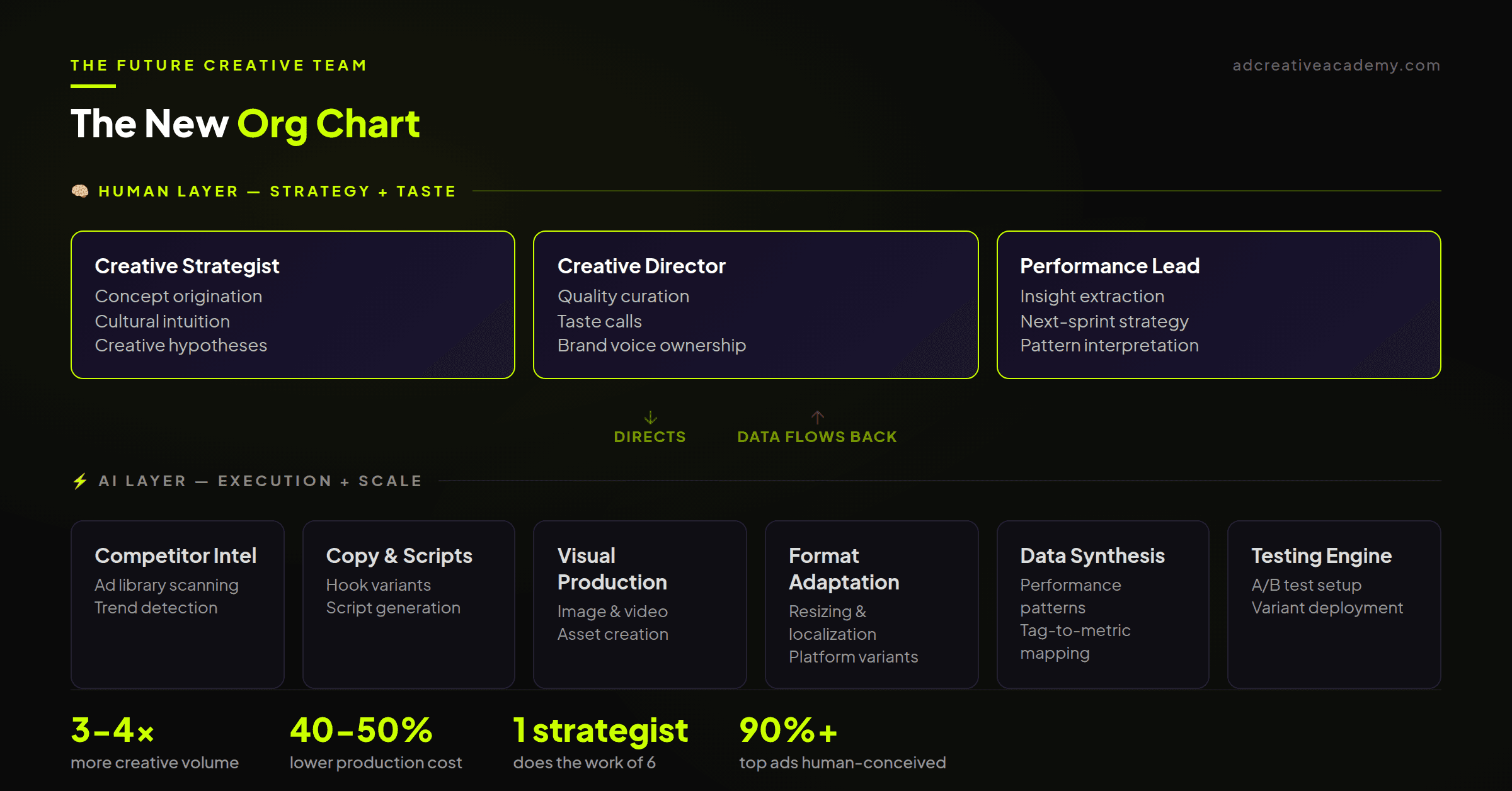
The model that the highest-performing teams are adopting has two distinct layers:
The Human Layer: Strategy + Taste
One or two senior creative strategists who own concept origination, cultural positioning, brand voice, and quality curation. They develop the creative hypotheses. They make the taste calls. They decide what the brand should say and why. A creative director who evaluates AI output against human standards, curates what's worth testing, and maintains creative quality. A performance lead who extracts insights from test results and translates them into strategic direction for the next sprint.
The AI Layer: Execution + Scale
AI agents handling competitive intelligence, ad library scanning, and trend detection. AI-powered copy and script generation, producing variants from human-created briefs. Visual and video production tools for rapid asset creation. Format adaptation systems for resizing, localization, and platform-specific versions. Data synthesis tools for performance pattern detection and tag-to-metric mapping. Testing engines for A/B deployment and variant management.
The Feedback Loop
Performance data flows from the AI layer back to the human layer. But not as raw numbers. As interpreted insight. The human strategist uses patterns to develop new hypotheses, new creative directions, new bets. The AI identifies what happened. The human decides what it means.
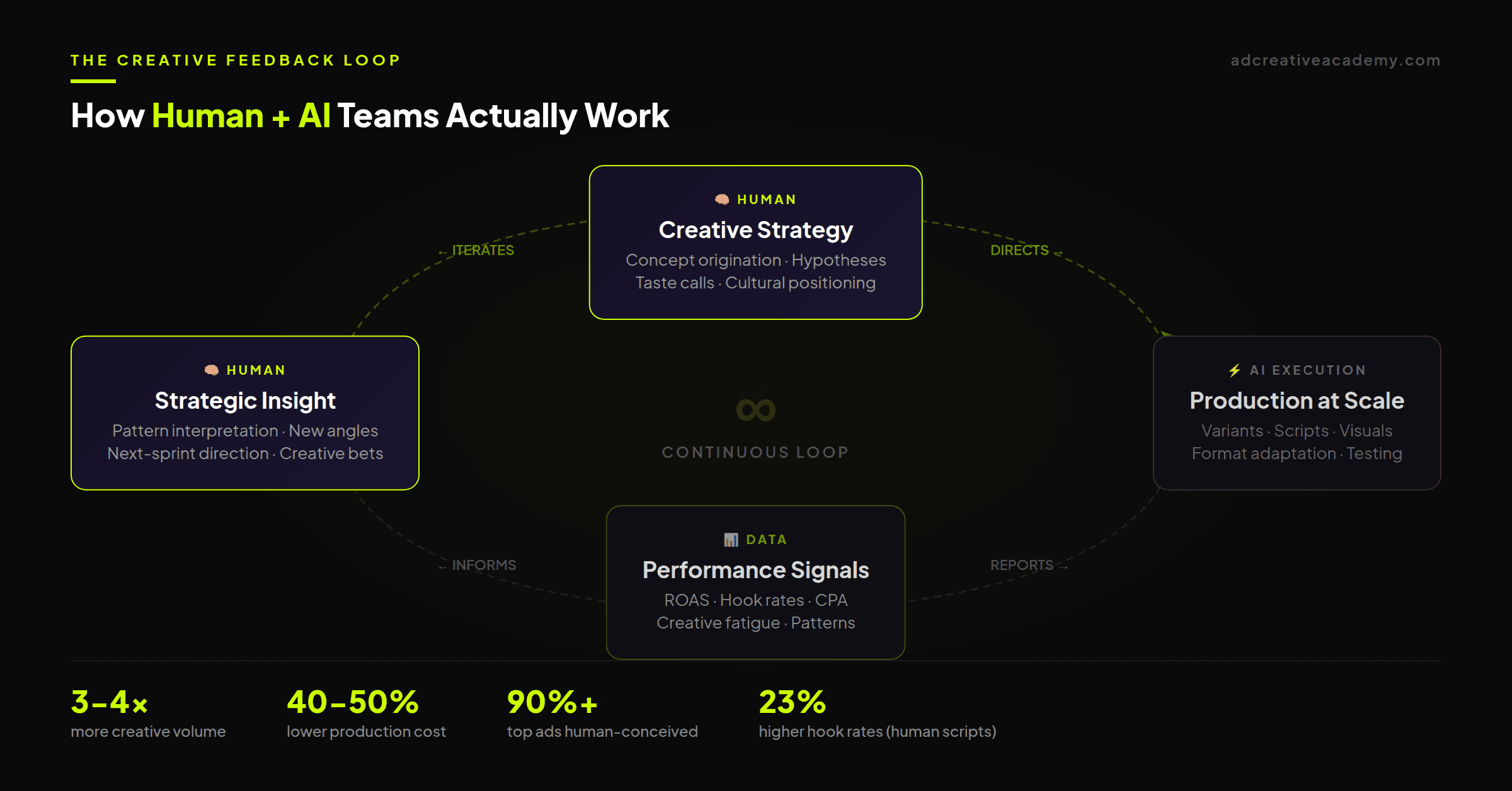
According to RocketShip HQ's client data, teams using this model produce 3-4x more testable creative at 40-50% lower production cost while maintaining or improving ROAS. A single senior strategist with AI tools can do the work that used to require a team of six.
Jesse calls this the shift "from creator to curator." Rory's framework is more direct: strategy in, volume out. The human does the thinking. AI does the making. And the human decides what's good.
The Counter-Argument: Why $100K Might Be Worth More, Not Less
Here's the counterintuitive truth that I think most people in our industry haven't fully processed yet.
As AI automates more of the advertising stack, the human creative strategist becomes the single biggest variable in whether a brand wins or loses.
Think about it. When everyone has access to the same AI tools. The same automated targeting. The same goal-only campaign systems. The same generative models. What's the differentiator?
It's not the technology. Everyone has the technology.
It's the thinking that goes into the creative input.
Meta's own research shows that creative accounts for up to 70% of campaign results. In a fully automated world where the platform handles the other 30% (targeting, bidding, optimization), creative quality is literally the only variable you can control.
The only lever. The only thing that separates your results from your competitor's results when you're both using the same AI on the same platform with the same automation.
And creative quality comes from creative strategy. From having a point of view about what your audience needs to hear. From understanding the cultural moment. From making creative bets that data alone wouldn't suggest because they require human insight to imagine.
The strategist who can do that isn't worth $100K. They're worth more. Because they're the last unfair advantage in a world where everything else has been commoditized.
What This Means for Your Career
I'm not going to sugarcoat this. If your version of creative strategy is primarily task-based (pulling reports, writing templated briefs, managing production timelines, resizing assets), the market for those skills is shrinking fast. AI does all of that faster and cheaper. That's not a prediction. It's already happening.
But if you're the kind of strategist who thinks, who has genuine creative taste, who understands audience psychology at a level that transcends data, who can make the judgment calls that AI can't, your value is increasing.
The creative strategists who thrive in this era will be the ones who:
Develop genuine creative taste by studying breakout campaigns, understanding why they worked, and building a point of view about what resonates with humans on an emotional level
Learn to direct AI like a creative director directs a team, knowing when the output is good enough and when it needs a human touch
Build deep audience empathy that goes beyond data, understanding the emotional landscape of the people they're trying to reach
Get comfortable with strategic ambiguity, making creative bets based on intuition informed by experience, not just what the dashboard says
Master the AI tools so thoroughly that they amplify your thinking rather than replace it
This is the exact intersection we built Ad Creative Academy around. Not just teaching people how to use AI tools (that part is table stakes). Teaching them how to think like the kind of strategist that AI can't replicate. The full stack: creative fundamentals, performance analytics, AI workflows, and the strategic judgment that connects them into a system that wins.
Our instructors (Ashley, Chloe, Carlotta, Jesse, Rory, Udi) have collectively managed hundreds of millions in ad spend and navigated this transition firsthand. They're not theorizing about the future. They're living it.
The Bottom Line
AI didn't kill the creative strategist. It killed the version of the role that should have been automated all along.
What remains is the hardest, highest-leverage part of the work. The part that requires genuine creative thinking. The part that requires being a person in the world with opinions, experiences, empathy, and taste.
In a world where everyone has the same technology, the last unfair advantage is a human mind that actually has something to say.
The question isn't whether AI will replace creative strategists. It's whether you're the kind of strategist who becomes 10x more impactful with these tools, or the kind who gets replaced because you were only ever doing the work that machines now do better.
I know which kind I want to be. And I know which kind we're training at Ad Creative Academy.
The conversation our industry keeps avoiding? Let's have it. I'm ready. Are you?